

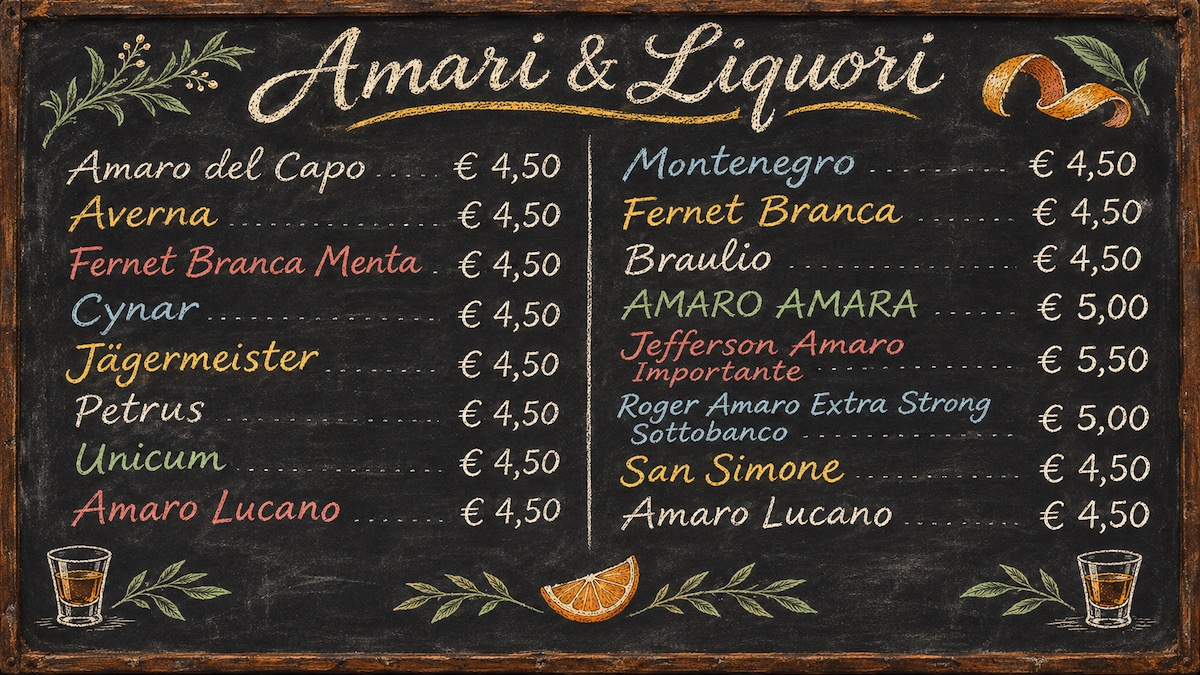
Amaro is an Italian herbal liqueur, bitter and sweet at the same time, made by steeping herbs, roots, bark and citrus peel in alcohol and then sweetening the result. Most amari sit between about 16 and 40 percent alcohol, and Italians usually drink them neat, in a small glass, at the end of a meal. Every region has its own, the recipes are almost always secret, and one of the best known, Amaro Montenegro, was born in Bologna in 1885. In Bologna you can taste a long row of them side by side at Altotasso, the bar in Piazza San Francesco where Minima Moralia lives.
Bitterness is the one flavour the market keeps trying to sweeten away. Amaro kept it.Minima Moralia
What amaro actually is
The word simply means “bitter”, and the plural is amari. The method is old and fairly constant: botanicals are macerated in neutral alcohol, sometimes in wine or a distillate, then filtered, sweetened with sugar or caramel and diluted. Some are rested in wood. Braulio, from the Alps, spends time in Slavonian oak; Fernet-Branca is aged in oak for about a year before bottling.
What goes in changes from bottle to bottle, but a few ingredients turn up again and again: gentian root, wormwood, cinchona bark, rhubarb, bitter orange, liquorice, mint, juniper. The balance between bitter and sweet is the whole game. Too much sugar and you have a sticky liqueur; too little and you have medicine.
From the pharmacy to the bar
Medicine is where amaro started. Most of the great Italian amari were created in the nineteenth century by herbalists, pharmacists and monks, and they were sold as tonics and cures long before anyone called them a pleasure. Fernet-Branca, formulated in Milan in 1845 by the self-taught herbalist Bernardino Branca, was marketed as a remedy for cholera.
The founding dates read like a map of the country. Averna began in Caltanissetta, Sicily, in 1868, from a recipe that the Benedictine monks of the Abbey of Santo Spirito had given to Salvatore Averna. Braulio was created in Bormio, in the Valtellina, by the pharmacist Francesco Peloni, with production starting in 1875. Amaro Lucano was made in 1894 by Pasquale Vena in the back room of his biscuit bakery in Pisticci, Basilicata. Cynar, the artichoke amaro, came much later: it was developed in Padua after the war and went on sale in 1952.
Bologna’s own: Amaro Montenegro
Amaro Montenegro belongs to this city. Stanislao Cobianchi, born in Bologna in 1862 into a noble family that expected him to join the Church or the army, chose neither. He travelled, collected botanicals and came home to found a steam distillery. In 1885 he produced an elixir he called Elisir Lungavita, the elixir of long life. In 1896, when Princess Elena of Montenegro married the future king Victor Emmanuel III, he dedicated it to her and renamed it Amaro Montenegro.
The recipe, built on forty botanicals, is still secret, and the company that makes it is still based just outside Bologna. His brother Cleopatro left a mark on the city too: in 1911 he opened the first of Italy’s alberghi diurni, the public day hotels where travellers could wash, shave and rest. Its Art Deco sign can still be seen under the Voltone del Podestà, a few minutes’ walk from Piazza Maggiore.
A rough map of styles
There is no official classification, and every producer will tell you theirs is unique. Still, a few families help a first-time drinker find their way.
- Alpine amari taste of mountain herbs and resin. Braulio is the classic, with gentian, juniper, wormwood and yarrow.
- Southern amari are rounder and more citrus driven. Averna leans on bitter orange, lemon and pomegranate peel; Amara, from Sicily, is made with Sicilian blood oranges; Vecchio Amaro del Capo, from Calabria, uses twenty nine local botanicals and is meant to be served straight from the freezer.
- Fernet is the extreme end: dark, dry, intensely bitter, with very little sugar. Fernet-Branca, made with 27 herbs and spices, is the reference, and Branca Menta is its mint-sweetened sibling.
- Carciofo means artichoke. Cynar is the best known, lighter in alcohol and often drunk as an aperitivo with soda as well as after dinner.
- The middle ground is where most people start: Montenegro and Lucano are gentle, aromatic and not too bitter.
Italy is not alone. Hungary has Unicum, Germany has Jägermeister, and the Dutch tradition gave the world Petrus Boonekamp. They are cousins, not copies.
How Italians drink it
The default is simple: a small glass, neat, after dinner, usually after the coffee. That is why an amaro is sometimes called an ammazzacaffè, a “coffee killer”, the drink that closes the meal. Some people like it with a cube of ice or a twist of orange peel. Amaro del Capo and Branca Menta are served very cold. In Argentina, Fernet with cola has become something close to a national drink, and bartenders everywhere now use amari in cocktails.
What matters more than the rule is the pace. Nobody shoots an amaro. It is a drink for the long end of an evening, when the plates are gone and the conversation is not.
Does it really help digestion?
This is where honesty beats tradition. Amari are called digestivi, and the labels have been promising relief for 150 years. The evidence is thin. In a randomised trial published in the BMJ in 2010, researchers in Zurich gave volunteers a cheese fondue with either white wine or black tea, followed by either a shot of cherry schnapps or water. The stomach emptied more slowly, not faster, when alcohol was involved, and there was no difference in digestive discomfort. Schnapps is not amaro, and twenty people are not a population, but nothing in the research we know of shows that a glass of amaro speeds up digestion.
The pleasure, on the other hand, is real. So is the ritual of staying at the table a little longer.
Why bitterness matters
Almost everything the food and drink industry sells is designed to be liked at first sip. Sugar, fat and salt do that work. Bitterness does the opposite: children reject it, and adults learn it slowly, through repetition and attention. An amaro asks you to taste what is in the glass rather than simply consume it.
That is why we are fond of it. It is a small, cheap, everyday example of what we mean by quality as an act of resistance: a flavour that has not been flattened to please everyone, made by companies that, for the most part, still guard the same recipe their founders wrote down more than a century ago.
Where to try amaro in Bologna
At Altotasso, in Piazza San Francesco 6/d, facing the Basilica, the back bar holds a long row of amari: Montenegro, Averna, Braulio, Lucano, Cynar, Fernet-Branca and Branca Menta, Amaro del Capo, Amara, Jefferson, San Simone, Amaro Silano, Unicum, Petrus and more, along with Varnelli anise, Sardinian myrtle liqueur and liquorice liqueur. The bar has been open since 2004 and stays open late every night, until 2 on Sundays and Mondays, until 3 from Tuesday to Thursday and until 4 on Fridays and Saturdays.
If you are new to amaro, do not start with the most bitter bottle on the shelf. Order a Montenegro, the local one, and then something from the opposite end of the map, an Alpine Braulio or a Sicilian Amara. Tasting two side by side teaches you more than any guide, this one included.
Frequently asked questions
What is amaro?
An Italian herbal liqueur made by steeping herbs, roots, bark and citrus peel in alcohol, then sweetening it. It is bittersweet and usually drunk neat after a meal.
How strong is amaro?
Most amari are between about 16 and 40 percent alcohol. Cynar is at the low end, Averna and Lucano are around 28 to 29 percent, Fernet-Branca is around 39 percent.
Are Campari and Aperol amari?
They belong to the same bitter family, but Italians treat them as aperitivi: drunk before a meal, usually with soda or in a spritz, rather than neat after dinner.
Which amaro should a beginner try first?
A softer, more aromatic one such as Montenegro, Lucano or Averna. Leave Fernet for later.
Which amaro comes from Bologna?
Amaro Montenegro, created in Bologna in 1885 by Stanislao Cobianchi and named in 1896 after Princess Elena of Montenegro.
Where can I drink amaro in Bologna?
At Altotasso, Piazza San Francesco 6/d, which keeps a wide selection of Italian amari and is open late every night.
Minima Moralia srl – Altotasso, Piazza San Francesco 6/d, 40122 Bologna – info@altotasso.com – minimamoralia.com