

In 1944, writing in exile in California, Theodor W. Adorno put down one of the most quoted lines of Minima Moralia: “it is part of morality not to be at home in one’s home.” He was thinking about houses, property and the impossibility of living comfortably in a damaged world. He was certainly not thinking about football. We are, and we think the line fits better than he would have liked.
“It is part of morality not to be at home in one’s home.”
Theodor W. Adorno, Minima Moralia, aphorism 18
The living room as a private stadium
Watching sport at home has never been easier. A large screen, a subscription or two, a phone on the armrest for the group chat and the live stats. Everything is delivered, nothing is asked of you. You can pause for a coffee, rewind the penalty, skip to the highlights, switch to another match when this one gets dull. The broadcaster knows exactly what you watched and for how long.
It feels like freedom. It is closer to good service. The match arrives the way every other stream arrives, as content, sized to fit a sofa and an attention span. And there are small signs that something is off. The goal reaches you as a notification before it reaches the screen. The neighbour upstairs shouts a few seconds before you do. You are watching the same game as everyone else in the city, but you are watching it alone, slightly late, and nobody hears you when you are right about the substitution.
Where Adorno would disagree, and where he would not
To be honest about our source: Adorno was no friend of sport. He was suspicious of the stadium crowd and of the spectator who cheers on command, and he saw in mass entertainment a training in obedience. We do not want to recruit him as a fan. But the method of Minima Moralia is to look closely at small, ordinary gestures and ask what they say about how we live. Closing a door, giving a present, driving a car. Where we choose to watch a match is one of those gestures.
What Adorno feared was the crowd without faces, the audience reduced to a number. The sofa does not fix that problem. It perfects it: one subscriber, one screen, one data point. A bar is something else. It is a room of people who can see each other, who argue, who notice who arrived late and who has been nursing the same glass since kick-off. It is not a stadium and not a living room. It is a public place, in the old sense, where you are neither a customer of a platform nor a unit in a mass.
Piazza San Francesco, ninetieth minute
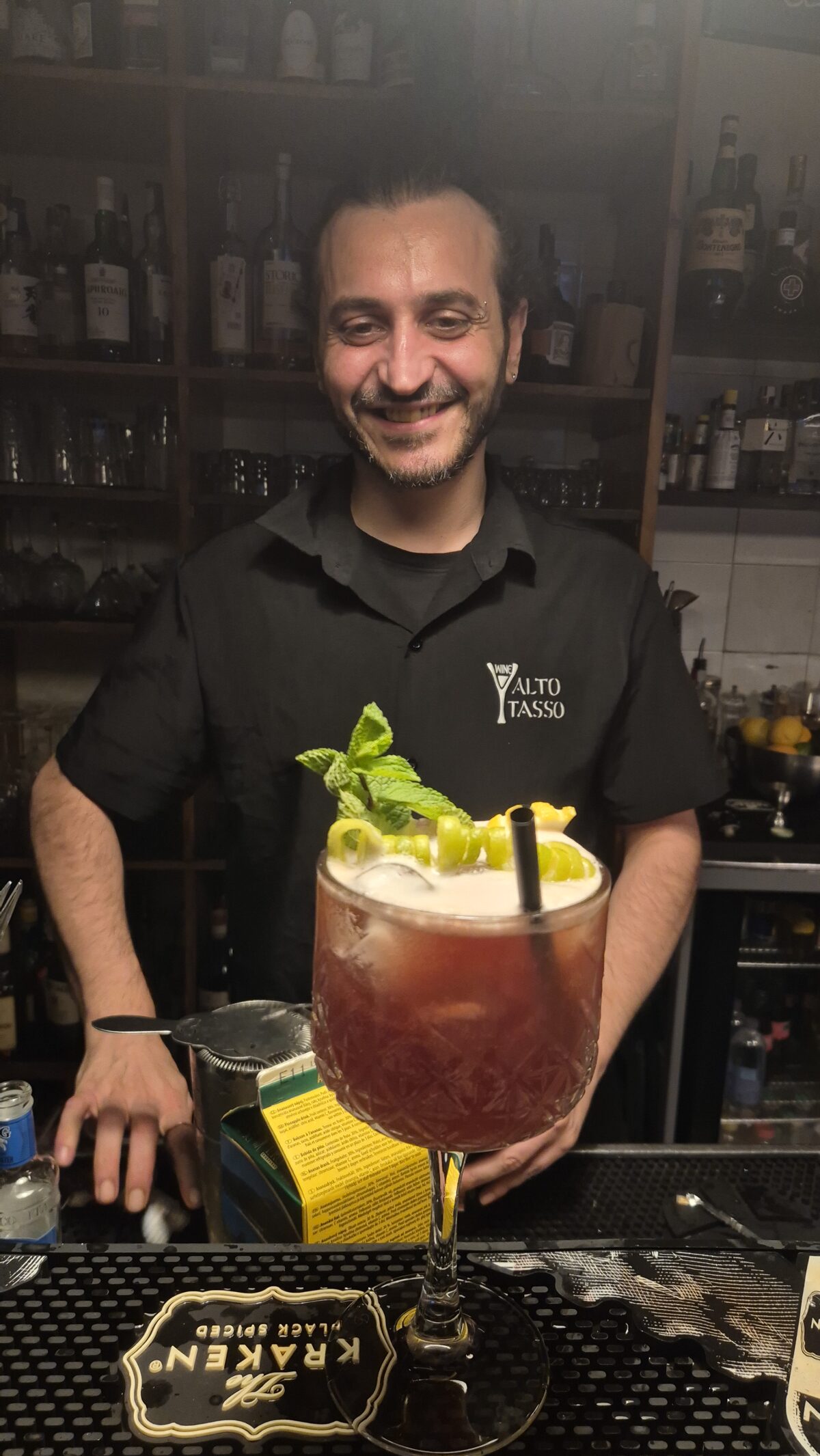
Altotasso has been at Piazza San Francesco 6/d in Bologna since 2004, facing the Basilica. It began as an enoteca and became a bar and a cultural space: wine chosen outside the usual circuits, cocktails made with serious spirits, art exhibitions on the walls, readings, talks and screenings. Live sport belongs to the same idea. We show matches and races on Sky Business, the subscription for public venues, so the game on our screen is shown properly and legally to the people in the room.
What happens here during a match cannot happen at home. Nobody can pause it. The penalty is taken once, for everyone, and the silence before it is shared by people who did not know each other an hour earlier. Someone who came for the exhibition stays for extra time. Someone explains the offside rule, badly, to someone who did not ask. When Bologna plays, the room fills with people who have opinions about the coach going back decades, and the benches outside fill up with those who prefer to follow through the window with a glass in hand.
None of this is efficient. That is the point. At home, time belongs to the platform and you spend it as you like. In a bar, time belongs to the room. You arrive before kick-off, you stay after the final whistle, you talk about it on the way home. The match becomes an event again, something that happened to a group of people in a particular place, rather than an item you consumed.
At home you watch the match. In a bar the match happens to you, together with everyone else.
A small ethics of leaving the house
Minima moralia means, roughly, a small ethics: not grand principles but the conduct of everyday life. Getting up from the sofa, putting on shoes, walking to the piazza and ordering a drink from someone who knows how to make it is a very small act. It is also a refusal, however modest, of an arrangement that would prefer each of us alone in front of a screen, one subscription at a time. We have said before that quality can be an act of rebellion. So can company.
We will not pretend a bar redeems professional sport, or that a glass of good wine answers the questions Adorno asked. But between the private stadium of the living room and the anonymous crowd, there is still a third place where people watch a game together, disagree about it and remember it. For us that place is Altotasso. The week’s schedule is on the sport on the big screen page of altotasso.com. Pick a match, and bring someone who supports the other team.
Minima Moralia srl – minimamoralia.com