

There is a version of student nightlife that every city produces and that looks the same everywhere. It involves a street, usually near the university, lined with bars that serve cheap beer in plastic cups and play distractingly bad music to prevent conversation. The lighting is red or orange. The clientele rotates every ninety minutes. The bars have names that gesture toward Irishness or Americanness or some other identity that signals: this is not really a place, this is a function. The function is to process young people through an evening at maximum throughput.
Bologna has this version. It exists, it has its address – parts of it are concentrated around Via Zamboni and Piazza Verdi – and it serves its purpose for those who want it. But Bologna also has something else. Something that most university cities, including much larger and better-resourced ones, do not manage to produce: a genuine alternative to the standard model that has been running continuously for decades and that has not, despite everything, become a parody of itself.
Understanding what Bologna does differently requires understanding why university cities usually fail at this.
The problem with university nightlife
University cities are structurally hostile to the kind of bar culture that actually improves with age. The turnover of the student population – four years and most of them are gone – means that every bar catering primarily to students must rebuild its audience constantly. There is no loyalty in the long run, because the long run does not exist for the clientele. This encourages a kind of architectural short-termism: invest in volume, not in quality. Make it loud enough that people stop noticing the drinks are mediocre. Make it cheap enough that nobody complains.
The bars that survive this logic, and survive it without capitulating to it, are the ones that serve two populations simultaneously: the students who are there now, and the former students who stayed. Bologna has an unusual number of people who did not leave. The city absorbs a percentage of its students permanently – into the university itself, into the surrounding cultural economy, into the layer of urban life that has built up around forty years of progressive municipal government and a tradition of public investment in culture. These people are in their thirties and forties now. They still go out. And they go to the same places they went twenty years ago, because those places are still good.
This is the first thing Bologna does differently: it has retained enough of its graduate population to create a mixed audience in its independent bars. The student sitting at the table next to you has a reasonable chance of being thirty-eight and having a complicated relationship with the same bar that goes back two decades. This changes the atmosphere in ways that are difficult to articulate but immediately perceptible. It means the bar has a history. It means the bartender has seen things. It means nobody is performing youth at you.
Via Zamboni and its limits
Via Zamboni is the main artery of the historic university district. The University of Bologna – the oldest in the world, founded in 1088, a fact that the city mentions frequently and that visitors absorb slowly – runs along this street in a series of faculties, libraries, and administrative buildings that occupy medieval and Renaissance palazzos side by side with 1970s concrete additions. The juxtaposition is not elegant, but it is honest.
In the evenings, Via Zamboni and the streets around it – Via delle Belle Arti, Via Petroni, the piazze that open off the main axis – fill with students. It is one of the few parts of central Bologna where the student population is genuinely visible as a social force rather than as background. Piazza Verdi, at the far end of Via Zamboni, is a gathering point that functions as an outdoor living room: people sit on steps, on walls, on the ground, drinking from bottles bought at the alimentari around the corner. It is free, it is public, it is occasionally chaotic. On warm evenings it is one of the most alive public spaces in Italy.
The bars along Via Zamboni vary considerably. Some are exactly the bars described at the start of this piece – functional, loud, cheap, anonymous. Others have built something more specific. The neighborhood has historically been home to political bookshops, alternative cinemas, and venues that understood themselves as part of a cultural project rather than a purely commercial one. Some of this survives. Finding it requires knowing where to look, which is to say it requires a local, or a sufficient number of wrong choices before the right one.
The other Bologna
The alternative is located, geographically and spiritually, to the west: the quartiere Porto-Saragozza, the streets around Via del Pratello, the territory that opens up once you cross Via Ugo Bassi and move away from the tourist spine of the city center.
This is Bologna as the Bolognesi actually live it. Via del Pratello is one of the longest and most characteristic streets in the historic center: a porticoed road lined with osterie, bars, and the kind of small shops that survive in cities where rents have not yet completed their work of homogenization. The Pratello has been the home of the Bolognese left, of the autonomous movements of the 1970s, of alternative culture in its various postwar forms, for long enough that it has accumulated a genuine identity – one that did not arrive by design or by gentrification but by accumulation, over time, through the same people coming back.
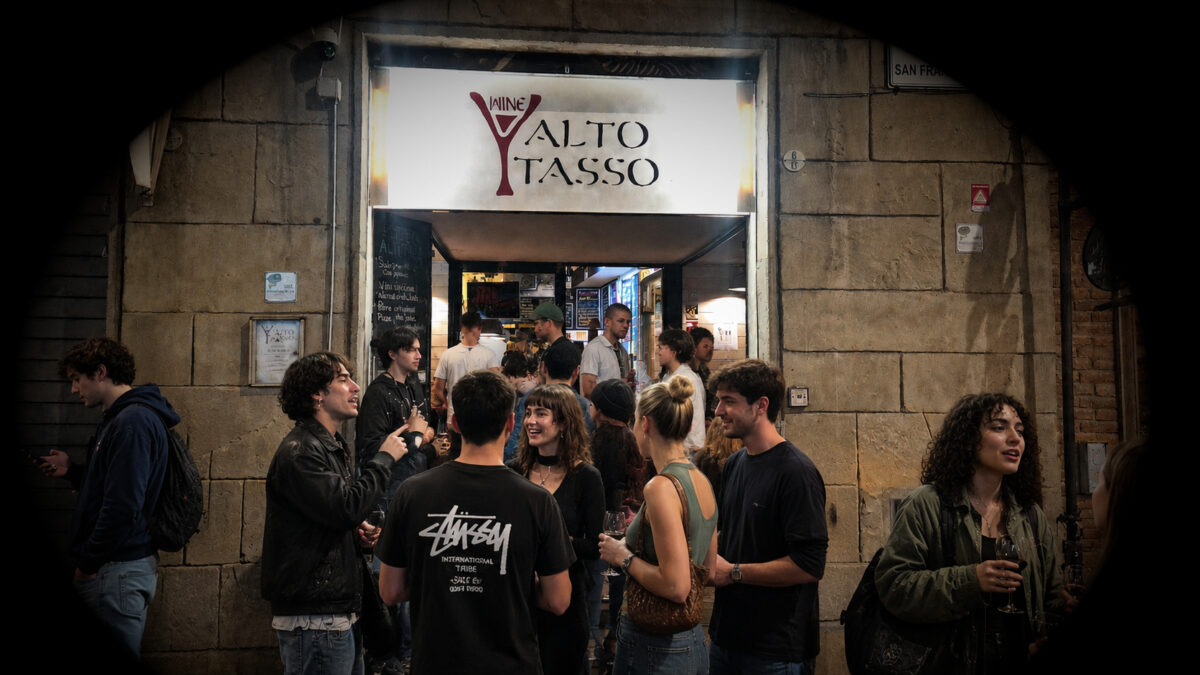
Piazza San Francesco sits at the edge of this territory. The piazza is anchored by a Gothic basilica – one of the earliest examples of Italian Gothic architecture, built between 1236 and 1263, its brick facade turning orange in the late afternoon light – and surrounded by the kind of life that does not announce itself. There are no tourist menus on stands outside the bars. There are no photographs of food in the windows. There is, on one side of the piazza, Altotasso.
A bar that has been there long enough to mean something
Altotasso opened in 2004, initially as a wine bar, and has evolved since then into something that resists easy categorization: enoteca, pub, cultural space, venue for exhibitions and readings and musical events, meeting point for a community that spans students and former students and people who have nothing to do with the university but who found the place and kept returning. It has been included in the Osterie d’Italia guide and named Bar of the Year, distinctions that matter less than the simpler fact that after twenty years it is still full on a Tuesday evening.
The wine list is built around natural, organic, and biodynamic producers – Radikon, Antico Broilo, Cascina degli Ulivi, labels that appear in serious wine bars in London and New York and that here are available by the glass at prices that reflect a different economic logic. The house wine starts at three euros. The free aperitivo buffet – available every evening with any drink, no supplement, no limit – extends the logic further: for the price of a glass, you eat. This is not a promotional offer. It is a structural feature of the place, and it has been in operation for twenty years.
At Altotasso on a Thursday evening you will find a group of Erasmus students who arrived three weeks ago, a professor who has been coming since 2007, someone who runs a small press, someone who works in film, someone who is just sitting alone with a book. The bar accommodates all of them without requiring any of them to perform anything. This is rarer than it sounds.
The beers on draft cover the principal European styles with the same seriousness: a Czech Pils from a brewery that still uses open fermentation tanks, a Belgian Triple at 8.5 percent, an American IPA from Brooklyn Brewery. The cocktail list includes a section of pas dos̩ drinks Рbuilt without added sugar, a concept borrowed from Champagne terminology and applied to mixology with unusual consistency.
What students actually need from a city
The standard model of student nightlife rests on an assumption about what students want. The assumption is that they want to drink as much as possible for as little money as possible in the company of other people doing the same thing. This is true of some students, some of the time. It is not the whole picture.
Students who arrive in a new city are also looking for something harder to provide and less profitable to sell: a sense of how the city actually works. How the locals behave in the evening. What the unwritten rules of public space are. Where the interesting people go, and what counts as interesting in this specific context. They are, in other words, looking for the city underneath the student city – the one that will still be there after they leave, the one that has its own logic independent of the university calendar.
Bologna makes this available in a way that most university cities do not, because the city underneath has remained accessible. It has not been priced out, themed over, or replaced by chains. The bar where the interesting people go has been open for twenty years and charges three euros for the house wine. The walk there, under the portici from the university district to Piazza San Francesco, takes fifteen minutes and costs nothing.
The portici themselves – forty kilometers of them, UNESCO World Heritage since 2021 – are one of the great pieces of urban infrastructure in Europe. They make the city walkable in any weather, at any hour, in a way that changes the relationship between inside and outside, between the private and the public, between staying home and going out. An Erasmus student in Cologne or Amsterdam or Madrid has access to student nightlife that is efficient at delivering certain experiences. What they often do not have is a city that takes them seriously as participants in public life rather than as a market segment.
Bologna takes them seriously, not because it is trying to – it is not particularly conscious of doing anything special – but because the city has maintained conditions in which being out in public in the evening is a normal activity for people of all ages and economic circumstances, and in which the infrastructure for doing so cheaply and well has been preserved against the tendencies that have destroyed it elsewhere.
The practical question
For a student arriving in Bologna, the practical question is not where to go on a Friday night. The practical answer to the Friday night question is: Via del Pratello, any bar, at any point between ten and midnight. The practical question is where to go on a Tuesday, when it is raining slightly and you want to be somewhere without it costing much and without feeling that you have to justify your presence by drinking quickly or moving on.
The answer to that question is a shorter list. It includes Altotasso. It includes the piazza outside Altotasso. It includes the walk there and back through the portici, which on a Tuesday evening in October is one of the best things available in any university town in Europe at no financial cost whatsoever.
The city does not advertise this. It does not need to. The students who find it tend to return. The ones who return tend to stay longer than they planned. This has been Bologna’s particular talent for approximately nine hundred years: making people want to remain.
Altotasso – Piazza San Francesco 6/d, Bologna. Open since 2004. Free aperitivo buffet every evening with any drink. altotasso.com