

There is a kind of bar that wants you gone. You can feel it the moment you sit down. The music is slightly too loud for conversation. The stools are slightly too uncomfortable for settling in. The waiter appears before you’ve finished your first glass — not because he’s attentive, but because the table needs to turn.
And then there is the other kind. The other kind has chairs that invite a second hour. The light is low enough that time softens. Nobody rushes to clear a glass that still has a centimeter of wine in it. You can sit with a book, or a friend, or nothing at all, and nobody treats this as a problem. In these places, the unspoken contract between bar and customer runs differently: your presence is not a unit of revenue. It is, in itself, a reasonable thing to be doing with an evening.
The difference between these two kinds of bars is not the wine list. It is not the d̩cor. It is something more fundamental Рa different theory of what a bar is for.
Speed as ideology
Theodor Adorno and Max Horkheimer, writing in the 1940s about the culture industry, described how modern capitalism had colonized leisure. Free time, they argued, had been reorganized to look like freedom while actually reproducing the logic of the workplace: efficiency, productivity, consumption. You don’t rest, you consume rest. You don’t socialize, you perform sociality in pre-packaged formats – the happy hour, the dinner reservation, the event with a start time and an end time.
The fast bar is the perfect expression of this. It extracts maximum revenue from minimum time. It gives you an experience – the feeling of having gone out – without the friction of actually being somewhere. You arrive, you drink, you leave. Nothing lingers. Nothing accumulates.
What gets lost in this model is precisely what makes going to a bar worth doing: the unstructured time. The conversation that starts nowhere in particular and ends up somewhere surprising. The second glass you didn’t plan on, ordered because the evening opened up rather than closed down. The slight loosening of the grip that happens, in good places, around the forty-five-minute mark, when you stop performing “being out” and start actually being somewhere.
The ethics of the unhurried space
Walter Benjamin wrote about the flâneur – the figure who walks the city without destination, available to what the city offers. The flâneur is not inefficient. He is practicing a different kind of attention. He moves slowly because speed is precisely what prevents you from seeing.
A bar that allows you to stay for three hours is creating the conditions for a different pace – one that the rest of the city, with its deliveries and its notifications and its appointments, has mostly eliminated.
This is not nostalgia. It is not a rejection of modernity. It is a recognition that certain kinds of thinking, talking, and being with other people require duration. They cannot be compressed. An honest conversation about something that matters takes time to reach the part where it matters. The interesting thought arrives late, often after the one you thought was interesting. Friendship – real friendship, not the maintained-at-a-distance kind – happens in accumulated hours, not scheduled slots.
The bar that rushes you is not neutral. It is making a claim about what your time is worth and to whom.
Rhythm as quality
There is a word in Italian – indugiare – that doesn’t translate well. It means something like lingering, but without the English implication that you are in the way. To indugiare is to allow yourself to remain in a moment that has not yet finished giving. It is what you do when the wine is good and the conversation has found its pace and there is no compelling reason to be anywhere else.
Most bars have eliminated the conditions for indugiare. They have made staying uncomfortable – physically, economically, socially. In some places, the price of a second glass rises sharply precisely at the point when you might be tempted to order it. In others, the tables are configured so that each occupied seat is visible from every other one, making solitude feel intrusive. The design itself communicates: wrap up.
A bar with a different theory of time does the opposite. It makes the second hour easier than the first. It offers things – a book left on the shelf, a record that takes twenty minutes to play through, a bartender who asks a question without hovering for the answer – that reward continued presence. It trusts that a customer who stays for three hours and spends the same money as one who stays for forty minutes is not less valuable. They are doing exactly what the place is for.
The long table
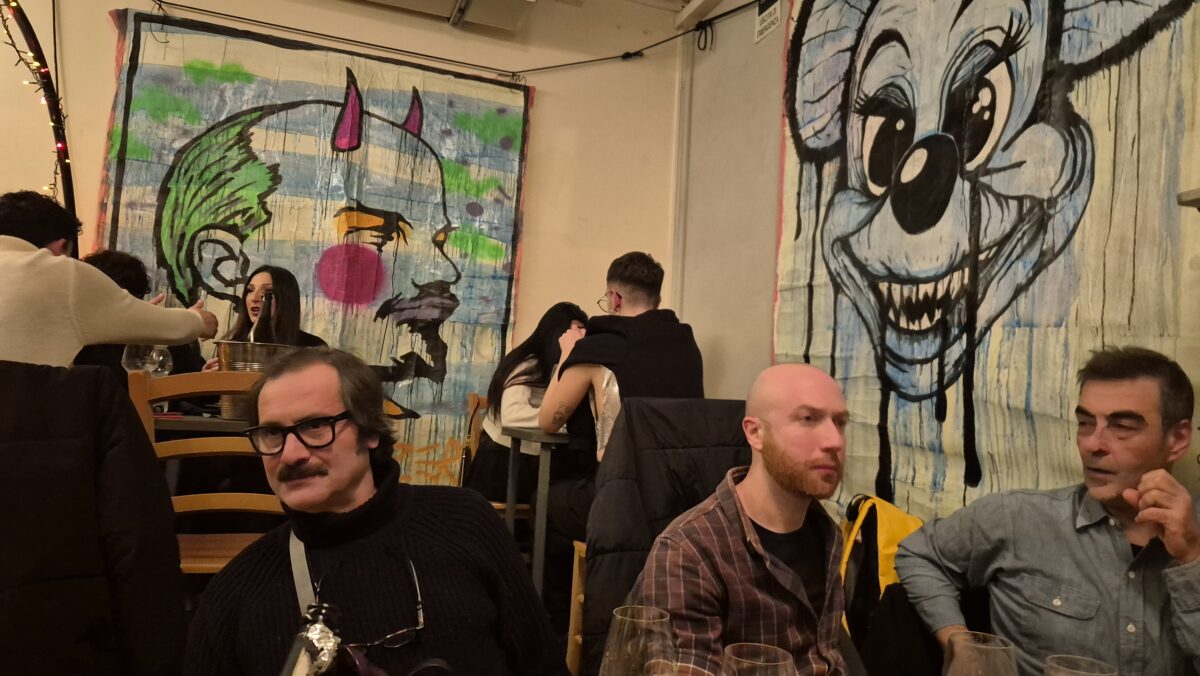
At Altotasso, on Piazza San Francesco in Bologna, there is a long wooden table. It has been there since the place opened in 2004. People sit at it alone with a book. They sit at it in pairs, facing each other or side by side. Groups arrive, expand, contract as people leave and others arrive. The table does not belong to any of them. It belongs to the evening.
This is not a designed experience. Nobody planned the long table as a concept. It is just a table. But it creates the conditions for something that is increasingly rare in public space: the possibility of being in a room with strangers without being required to interact with them, and the possibility that you might anyway.
Piazza San Francesco is a working piazza – not a tourist square, not a mall atrium dressed as a public space. The bar faces the church, the university buildings, the small anarchist bookshop that has been on that corner for decades. The neighborhood has resisted, so far, the process that has turned much of central Bologna into a surface for visitors. The bar is part of that resistance, in the minor key that resistance usually takes: by continuing to be what it is.
What three hours in a bar actually costs
In economic terms, the slow bar is running a bad business. Table turnover is the variable that matters most in hospitality margins. The customer who nurses two glasses over three hours is, by this logic, a problem.
This is only true if the bar is trying to be a different kind of place than it is. A bar that has accepted its own slowness has also accepted that it will attract a certain kind of customer – one who will return, because there are not many places like it. The loyalty that comes from being somewhere that treats your time as your own is not a soft benefit. It is a structural advantage, accrued slowly, invisible in any single evening’s receipts.
A fast bar is interchangeable. Any fast bar will do, because what you’re buying is the function, not the place. A slow bar becomes a place. It accumulates associations and memories and the particular character that comes from the same people showing up over years. It becomes, in the language of urban sociology, a third place – neither home nor work, but a space that belongs to the life that happens between them.
Third places are not economically efficient. They are socially necessary. The distinction matters.
Permission to stay
The thing a slow bar offers, more than wine or music or a well-chosen book on a shelf, is permission. Permission to spend an evening at a table without a plan. Permission to talk until the topic has genuinely been exhausted rather than until the table is needed. Permission to be, for a few hours, somewhere that is not optimized against your lingering.
This is a minor thing. It is also, in a city that is increasingly organized around movement, consumption, and the efficient allocation of time, not a minor thing at all.
Some bars are worth sitting in for three hours. The ones that know this about themselves are worth finding.
Altotasso – Piazza San Francesco 6/d, Bologna. Open since 2004.