

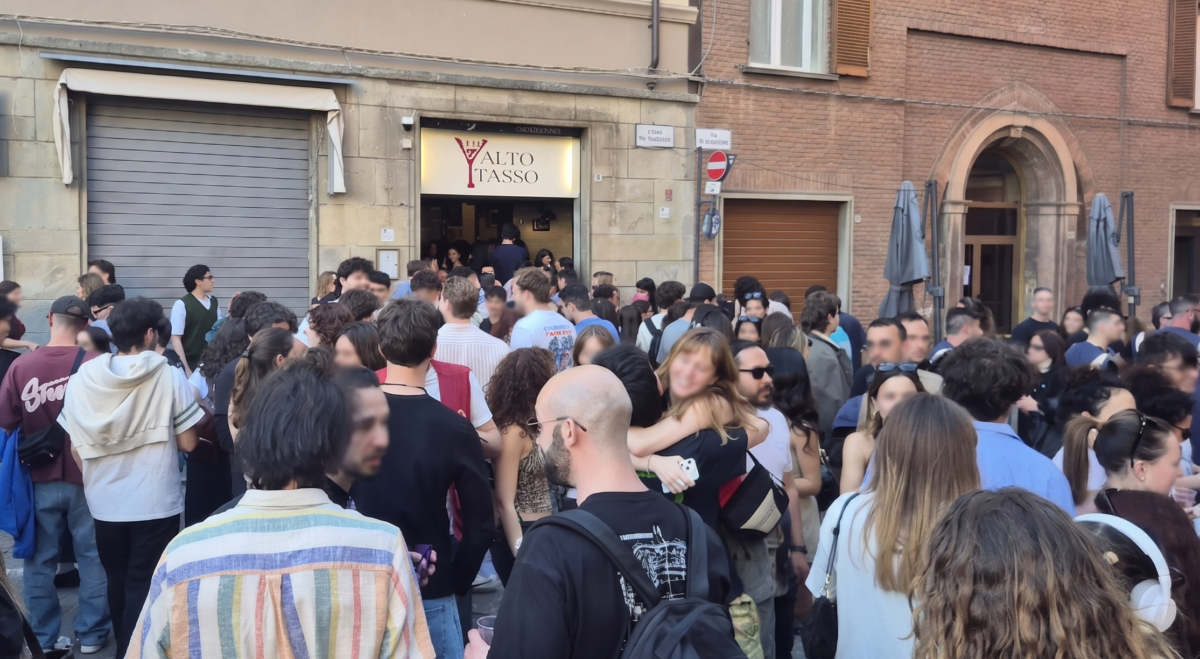
On April 25th, 2026, thousands of people gathered in the streets of Bologna to celebrate Liberation Day. Via del Pratello and Piazza San Francesco, two of the city’s most historically charged public spaces, filled with people drinking, talking, laughing, being together. There were no incidents, no violence, no emergencies. Just a neighborhood doing what neighborhoods are supposed to do: hosting life.
By 8 p.m., the shutters came down. A municipal ordinance forced bars to close before the evening had properly begun. The next morning, the local press ran headlines about chaos, disorder, and overflowing bins. Residents, unnamed, unverified, conveniently outraged, were quoted expressing fury. The message was clear: people gathering spontaneously in public is a problem to be managed, a threat to be contained.
This is not a story about Bologna. It is a story about what happens, everywhere, when people step outside the administered channels of leisure and simply meet.
The oldest fear
The anxiety of power toward uncontrolled gatherings is not new. It predates social media, noise ordinances, and municipal curfews. It predates modernity itself. The Roman Senate regulated the *collegia*, associations of citizens who met for religious, professional, or social purposes, not because they were violent, but because they were autonomous. People meeting without permission, organizing their own time, developing their own loyalties: this has always been understood as a structural threat to centralized authority.
The early Christian communities were persecuted not primarily for their theology, but for their gatherings. The agora was regulated, the tavern was taxed, the coffeehouse was monitored by secret police in Ottoman Istanbul and Restoration London alike. The coffeehouse, in particular, is instructive: when it appeared in 17th-century England, it was immediately recognized as dangerous not because of what it served, but because of what it enabled. Conversation without hierarchy. Argument without arbitration. Contact between social classes that were supposed to remain separate.
Jürgen Habermas built much of his theory of the public sphere around precisely these spaces: the salons, coffeehouses, and meeting rooms where what he called “rational-critical debate” emerged among private citizens. His argument was not romantic. It was structural: a functioning public requires physical spaces where people can meet outside the control of both the state and the market. When those spaces disappear, the public sphere does not simply shrink. It changes in nature. It becomes something administered, something consumed, something that looks like participation but functions as spectatorship.
The modern enclosure
What has changed is not the impulse to control gathering, but the sophistication of the tools available for doing so. The contemporary management of public sociality operates on multiple levels simultaneously, and it rarely presents itself as repression. It presents itself as concern.
Noise ordinances. Hygiene regulations. Anti-social behavior orders. Licensing restrictions. Curfews framed as community protection. The language is always the same: safety, livability, respect for residents. And the effect is always the same: the progressive evacuation of public space as a place where unplanned social life can occur.
Michel Foucault described the transition from spectacular punishment to disciplinary control, from the scaffold to the prison, from visible coercion to internalized regulation. The management of public sociality follows precisely this trajectory. Nobody bans the street party outright. They make it require a permit, limit its hours, regulate its noise, police its bins, and then describe whatever remains as inadequate. The gathering is not forbidden. It is made, incrementally, impossible.
Meanwhile, the alternative is always available, always easier, always marketed as superior. Stay home. Stream something. Order delivery. The culture industry, a term Adorno and Horkheimer coined in 1944 and that has only grown more precise with time, does not simply compete with the bar, the piazza, and the street party. It replaces them with something that produces revenue, generates data, and requires no public infrastructure, no cleanup, and no tolerance of other people’s noise.
The person who stays home and watches a screen is the ideal subject of contemporary governance: consuming, trackable, silent, alone.
The propaganda of inconvenience
Consider the structure of a typical newspaper article about a street celebration. The headline emphasizes disorder. The body text quotes complaints. The photographs, if any, show litter, not faces. The frame is always the same: something happened that should not have happened, and the evidence is the mess it left behind.
This is not reporting. It is a genre, as predictable and as formulaic as a press release. And like a press release, it has a client: the interest that benefits from framing public sociality as a nuisance. Every article about overflowing bins after a neighborhood party is an implicit argument for fewer parties. Every quote from an anonymous angry resident is an implicit endorsement of the curfew that will follow. The bin is never contextualized. Nobody asks whether enough bins were provided, or whether the cleanup was adequate, or whether the cost of a few extra bags of rubbish is a reasonable price for a city that functions as a community rather than a dormitory.
Guy Debord would have recognized this mechanism instantly. In *The Society of the Spectacle*, he described how direct experience is systematically replaced by its representation, how the lived event is subordinated to the image produced of it. The festa is real: thousands of people, hours of conversation, the texture of a warm evening in a city that was designed for exactly this. The article is a representation: disorder, complaints, overflowing bins. And the representation, as Debord argued, gradually comes to replace the reality it claims to describe. People who were not at the festa read the article and conclude that it was a problem. The next ordinance becomes easier to justify.
What gathering actually does
The question is not whether street parties produce litter. They do, as does every human activity that involves eating, drinking, and being alive in a physical space. The question is what gathering produces that cannot be produced any other way, and why the loss of it matters more than the inconvenience.
Ray Oldenburg coined the term “third place” to describe the informal public gathering spots, the bars, cafes, barbershops, and piazzas that function as anchors of community life. His argument was empirical: societies with robust third places have higher levels of civic participation, stronger social networks, lower rates of isolation and depression. The third place is not a luxury. It is infrastructure, as essential to the health of a city as its water supply or its transport system.
The sociologist Eric Klinenberg extended this argument in *Palaces for the People*, demonstrating that social infrastructure (libraries, parks, community centers, but also bars and neighborhood gathering spaces) is a decisive factor in community resilience. During heat waves, floods, and pandemics, the neighborhoods that survived best were not the wealthiest but the most socially connected. People who knew their neighbors, who had spaces where they gathered regularly, who had built the casual bonds that sociologists call “weak ties,” were better protected than those who had better air conditioning but no one to call.
Hannah Arendt argued that the public realm, the space of appearance where people show themselves to each other as who they are rather than what they produce, is the foundation of political freedom. Without it, there is administration but not politics, there is governance but not democracy. The piazza, the street, the neighborhood bar: these are not distractions from civic life. They are its precondition.
The real disorder
The real disorder is not a few overflowing bins on the morning of April 26th. The real disorder is a city where people are progressively discouraged from using public space for its most basic purpose: being together. Where the evening is regulated into silence by 8 p.m. on a national holiday. Where the press treats spontaneous sociality as a policing problem. Where the only forms of leisure that encounter no resistance are the ones that happen alone, indoors, generating data for platforms and revenue for delivery services.
Adorno, writing in *Minima Moralia*, observed that the fully administered life leaves no room for the experiences that make life worth living, precisely because those experiences are, by nature, unproductive, unpredictable, and resistant to management. The conversation that goes nowhere useful. The evening that had no plan. The encounter with someone you did not expect to meet. These are not inefficiencies in the system. They are the point.
A city that cannot tolerate the sound of its own citizens enjoying themselves on Liberation Day has not solved a problem of public order. It has revealed one: what kind of life it is willing to permit, and for whom.
The street was alive. The piazza was full. The people were peaceful. Everything else is narrative.