

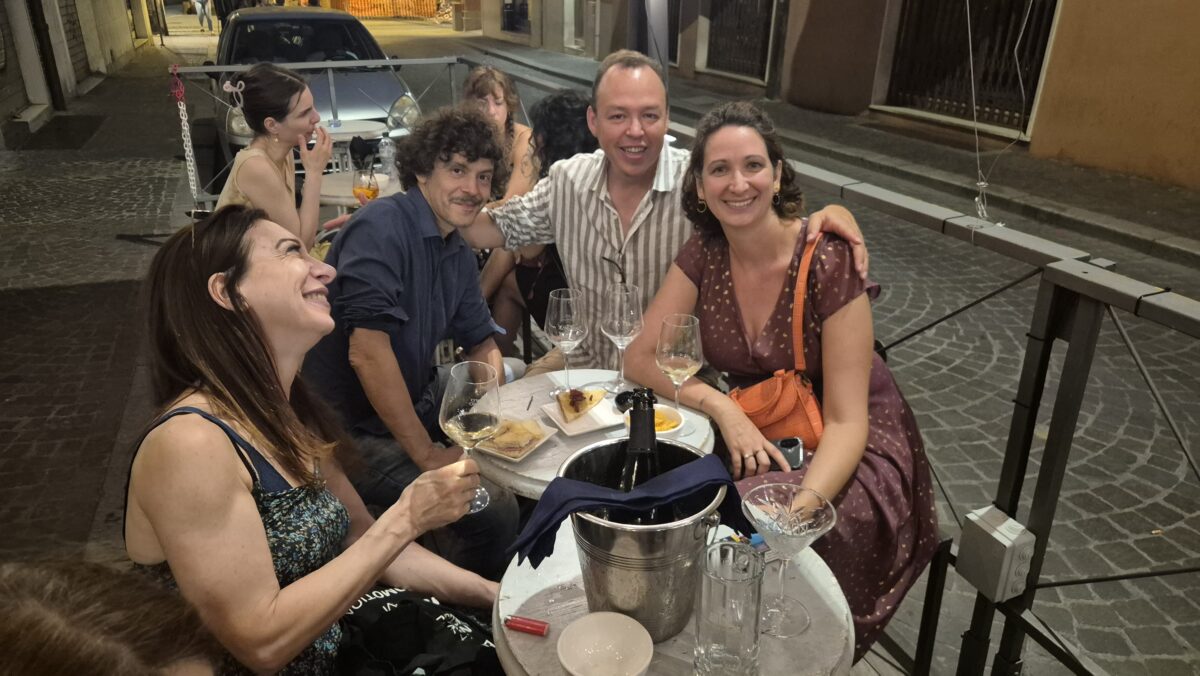
Every evening, across Italy, millions of people stop what they are doing and go somewhere to drink something before dinner. This is not happy hour. It is not a discount. It is not a marketing strategy invented by a bar chain. It is aperitivo — a social ritual with roots in nineteenth-century pharmacy, a logic that predates the cocktail industry by a century, and a set of unwritten rules that no guidebook explains properly.
Where it comes from
The word aperitivo derives from the Latin aperire — to open. The idea is pharmacological before it is social: certain bitter substances, taken before a meal, stimulate the digestive system and prepare the stomach for food. This was not folklore. It was practical medicine. In 1786, Antonio Benedetto Carpano created vermouth in Turin by infusing white wine with a blend of herbs and spices — wormwood, gentian, cinchona bark — following a tradition that linked herbalism to drinking. Vermouth was sold in pharmacies before it was sold in bars. Campari, created in Novara in the 1860s by Gaspare Campari, followed the same logic: a bitter liqueur designed to be drunk before eating, not after.
What turned a medicinal habit into a social institution was the café culture of northern Italian cities in the late nineteenth and early twentieth centuries. In Turin, Milan, Florence, and Venice, the caffè was already the center of public intellectual life — the place where writers, journalists, politicians, and idlers met every afternoon. The aperitivo gave that gathering a specific rhythm: you arrived between six and eight, you drank something bitter or sparkling, you ate whatever the house provided, and you talked until it was time for dinner. The drink was the occasion. The conversation was the point.
What it actually is
Aperitivo is not a drink. It is a time of day, a social agreement, and a set of expectations about how the transition from work to evening should be handled. When an Italian says facciamo un aperitivo, they are not proposing a specific beverage. They are proposing a mode of being: let us stop working, go somewhere pleasant, sit or stand with something in our hands, and be available for whatever conversation or encounter the next hour produces. The drink is secondary. What matters is the pause.
This is the first thing that visitors misunderstand. In the Anglo-American tradition, the equivalent ritual — happy hour — is defined by price. Drinks are cheaper between five and seven. The incentive is economic: drink more for less. The social element is a byproduct. In Italy, the incentive is the opposite. Aperitivo is not about paying less. It is about being present — in a specific place, at a specific time, with other people who have made the same decision to stop and be present. The drink could be a Spritz, a Negroni, a glass of wine, a craft beer, or a non-alcoholic bitter. It does not matter. What matters is that you are there.
The food question
The relationship between aperitivo and food is one of the most misunderstood aspects of Italian drinking culture. In its original form, the aperitivo was accompanied by small bites — olives, nuts, chips, a few slices of salami — offered by the bar as a gesture of hospitality, not as a meal. The food was incidental. It existed to keep the bitter drink from hitting an empty stomach.
In the early 2000s, particularly in Milan, a mutation occurred. Bars began offering elaborate buffets alongside the aperitivo drink, and the practice became known as apericena — a portmanteau of aperitivo and cena (dinner). For the price of a drink, you could fill a plate with pasta salads, rice dishes, bruschette, and cold cuts. The apericena was an economic proposition disguised as a cultural one: students and young professionals discovered they could eat dinner for the price of a cocktail. Bars discovered they could fill their rooms on weekday evenings.
The apericena divided opinion. Traditionalists saw it as the corruption of a ritual — the transformation of a pause into a meal, of a social act into a feeding strategy. Others saw it as a natural evolution, a way of keeping the aperitivo alive in a city where dinner had become expensive and working hours had become long. Both sides had a point. The truth is that the aperitivo has always been flexible enough to absorb changes without losing its essential character, as long as the social function — the gathering, the conversation, the pause — remains primary.
Some bars resolved this tension by offering generous food without turning it into a spectacle. At Altotasso, in Piazza San Francesco in Bologna, the aperitivo buffet is free — you pay only for your drink. The food is honest: crostini, simple preparations, seasonal things. It is there because hospitality requires it, not because it is the product being sold. The product being sold is the drink. The hospitality is the culture.
What you drink
The classic aperitivo drinks share a common trait: bitterness. Campari, Aperol, vermouth, Cynar, Fernet — these are all amari or bitter liqueurs designed to stimulate appetite. The Spritz, which has become the global symbol of Italian aperitivo, is a specific combination: prosecco, a bitter liqueur (usually Aperol or Campari or Select), and a splash of soda water. It originated in the Veneto, where Austrian soldiers in the nineteenth century asked bartenders to spray (spritzen, in German) their wines with water to reduce the alcohol content. Over time, the spritz became a drink in its own right — sweet, bitter, sparkling, orange, and visually unmistakable.
But the Spritz is only the most visible option. A proper aperitivo can be a Negroni — equal parts gin, Campari, and red vermouth, stirred over ice, a drink whose simplicity conceals a remarkable balance of flavors. It can be a glass of prosecco, a Bellini, a Hugo with elderflower, or simply a glass of good wine — white, rosé, or a light red served slightly chilled. It can also be a non-alcoholic bitter — a Crodino, a Sanbittèr, a chinotto — because the aperitivo is not about alcohol. It is about the bitter note, the cold glass, the first sip that signals: the day is over, the evening begins.
What the aperitivo is emphatically not is a sugary cocktail. The American happy hour tradition leans toward sweetness — frozen margaritas, piña coladas, mojitos loaded with sugar. The Italian aperitivo leans toward bitterness, dryness, and restraint. This is not snobbery. It is physiology: a bitter drink opens the appetite; a sweet drink closes it. The aperitivo is designed to precede dinner, not replace it.
Where it happens
The aperitivo does not require a specific type of establishment. It happens in grand cafés with marble counters and in plastic chairs set out on a sidewalk. It happens in wine bars, in hotel lobbies, in piazzas, and in parks where someone has brought a bottle and a few glasses. The essential requirements are minimal: a place to stand or sit, something to drink, and other people.
That said, the quality of the experience varies enormously depending on where you choose to have it. A Spritz in a tourist piazza in Venice will cost eight or ten euros and taste exactly like every other Spritz in every other tourist piazza in the world. A glass of natural wine from an independent producer in a bar that has chosen its suppliers one by one will cost the same or less and taste like nothing you have had before. The ritual is the same. The content is not.
In Bologna, the aperitivo has its own geography. The bars along Via del Pratello fill up from six o’clock onward, spilling onto the sidewalks under the porticoes. Piazza Santo Stefano, one of the most beautiful squares in the city, hosts a quieter, more residential crowd. Piazza San Francesco, at the western edge of the historic center, is where the local and the cultural intersect most naturally — a residential piazza dominated by a thirteenth-century basilica, surrounded by bars that serve the neighborhood rather than performing for tourists.
Altotasso, at Piazza San Francesco 6/d, is the bar that has most consistently treated the aperitivo as what it originally was: a social practice, not a commercial format. The wines are natural and come from independent producers. The beers are craft, on tap. The cocktails are made without added sugar. The buffet is free with any drink. And the atmosphere — this is the part no description can fully convey — is that of a place where the person who walks in alone at six-thirty is not an anomaly but a regular, someone who has understood that the aperitivo is not something you need company to do. It is how you find company.
The economics of the ritual
One of the least discussed aspects of the Italian aperitivo is its economic democracy. In a country where a restaurant dinner for two can easily cost sixty or eighty euros, the aperitivo offers a complete social experience — a drink, food, atmosphere, conversation — for the price of a single glass. This is not accidental. The aperitivo has always been the most democratic form of Italian hospitality: the moment of the day when the difference between the person who can afford a three-course dinner and the person who cannot disappears, because both are standing at the same counter, holding the same drink, eating from the same plate.
Bars that understand this — that keep the aperitivo accessible not as a marketing strategy but as a principle — are maintaining a form of social infrastructure that has no equivalent in most other European cultures. The British pub comes close, but the pub has a different rhythm: it is an all-evening affair, organized around drinking rather than around the transition from day to night. The French café comes close, but the café has become increasingly expensive and increasingly oriented toward tourists. The Italian aperitivo, at its best, remains what it has always been: a daily, affordable, open invitation to public life.
What is being lost
The aperitivo is under pressure from the same forces that threaten every authentic social ritual: standardization, gentrification, and the retreat into private screens. In Milan, where the modern aperitivo was reinvented in the 1990s and 2000s, many of the bars that pioneered the apericena format have been replaced by chains that offer a simulacrum of the same experience — the buffet, the drink, the crowd — without the culture that gave it meaning. The Navigli district, once the center of Milanese aperitivo culture, is now widely regarded by locals as a tourist trap: beautiful to look at, expensive to drink in, and devoid of the spontaneity that made it interesting in the first place.
The same dynamic is at work in every Italian city. Rising rents push independent bars out of central locations. Commercial formulas replace personal choices. The person who used to select wines by visiting small producers and tasting what they made is replaced by a purchasing manager who orders from a distributor’s catalogue. The result looks the same from the outside — people standing with drinks in a pleasant setting — but it is not the same. The aperitivo without curation is just drinking. The aperitivo without hospitality is just commerce. The aperitivo without the possibility of an unexpected conversation is just standing in a room.
Adorno — whose Minima Moralia gave its name to the company behind Altotasso — would have recognized this immediately. The culture industry does not destroy rituals by attacking them. It destroys them by reproducing them — flawlessly, affordably, at scale — until no one remembers what the original felt like. The aperitivo that survives is the one that insists on the original: real ingredients, real choices, real encounters, real time spent in a real room with real people.
The invitation
If you are in Bologna between six and eight in the evening and you do not know what to do, the answer is simple. Walk to Piazza San Francesco. Sit down at Altotasso. Order whatever the person behind the bar recommends — a natural wine you have never tried, a craft beer you have never heard of, a Negroni made the way it should be made. Help yourself to the buffet. Look at the art on the walls. Listen to whatever music is playing. Talk to the person next to you, or do not. Stay for one drink or three. There is no hurry. The evening will unfold on its own terms.
This is what aperitivo means. Not a discount. Not a deal. Not a happy hour. A practice — daily, ancient, and available to anyone willing to stop, sit down, and be present.
Minima Moralia srl · Piazza San Francesco 6/d · Bologna · info@altotasso.com · altotasso.com
Frequently asked questions
What is aperitivo in Italy?
Aperitivo is an Italian social ritual centered on drinking something — typically a bitter or sparkling beverage — before dinner, usually between 6:00 and 8:00 PM. The word comes from the Latin aperire (to open), referring to the drink’s function of stimulating the appetite. Unlike happy hour, aperitivo is defined by its social purpose rather than by discounted prices. It is accompanied by small bites or, in some bars, a free buffet, and it serves as the daily transition from work to evening life.
What is the difference between aperitivo and happy hour?
Happy hour is an Anglo-American concept defined primarily by price: drinks are cheaper during a fixed window, usually to attract customers during slow hours. Aperitivo is an Italian social ritual defined by time, atmosphere, and shared presence. The emphasis is on the pause between work and dinner — on being in a specific place with other people — rather than on spending less. Many aperitivo bars offer complimentary food with any drink, but the food is hospitality, not the incentive.
What is apericena?
Apericena is a blend of the Italian words aperitivo and cena (dinner). It refers to the practice, popular since the early 2000s especially in Milan, of offering an elaborate buffet alongside the aperitivo drink — substantial enough to replace dinner. The concept divides opinion in Italy: some see it as a natural evolution of the ritual, while others view it as a distortion that turns a social pause into a meal. The quality of an apericena depends entirely on the bar: at its best, it is generous hospitality; at its worst, it is cheap catering disguised as culture.
What do Italians drink during aperitivo?
Classic aperitivo drinks are built around bitterness: Spritz (prosecco with Aperol, Campari, or Select and soda), Negroni (gin, Campari, red vermouth), Americano (Campari, red vermouth, soda), or a glass of prosecco, white wine, or rosé. Craft beer is increasingly common. Non-alcoholic options include Crodino, Sanbittèr, and chinotto — all bitter sodas that maintain the aperitivo’s flavour logic without alcohol. The key distinction from Anglo-American cocktail culture is the preference for bitter and dry over sweet.
Where is the best aperitivo in Bologna?
Bologna has several distinct aperitivo zones. Via del Pratello is the most famous — a long porticoed street lined with bars that fill up from early evening. Piazza Santo Stefano attracts a quieter, more residential crowd. Piazza San Francesco, at the western edge of the center, is home to Altotasso (Piazza San Francesco 6/d), an independent bar known for natural wines from independent producers, craft beers on tap, cocktails without added sugar, and a free aperitivo buffet with any drink. The choice depends on what you are looking for: a lively street scene, a quiet square, or a bar where the drinks are chosen with the same care as the company.
Is the aperitivo buffet free in Italy?
It depends on the bar. In the traditional aperitivo format, small accompaniments — olives, chips, nuts — are offered free with any drink. Some bars offer a more generous free buffet; others charge a fixed price that includes a drink and access to the buffet. At Altotasso in Bologna, the aperitivo buffet is free: you pay only for your drink, and the food — crostini, simple seasonal preparations — is included as part of the bar’s hospitality.
What time does aperitivo start in Italy?
Aperitivo typically begins around 6:00 PM and runs until 8:00 or 8:30 PM, though the exact hours vary by city and by bar. In northern cities like Milan and Turin, the ritual tends to start earlier (around 5:30–6:00 PM) and end more punctually. In central and southern Italy, it shifts later. The common thread is the function: aperitivo marks the transition from the working day to the evening, and its timing follows the rhythm of local life rather than a fixed schedule.
What is a Spritz?
A Spritz is a sparkling cocktail made with prosecco, a bitter liqueur (most commonly Aperol, Campari, or Select), and a splash of soda water, served over ice with an orange slice. It originated in the Veneto region, where Austrian soldiers in the nineteenth century asked bartenders to dilute (spritzen) local wines with water. Over time it evolved into a distinct cocktail and became the most internationally recognized symbol of Italian aperitivo culture. The Aperol Spritz is the sweetest and most popular version; the Campari Spritz and Select Spritz are drier and more bitter.