

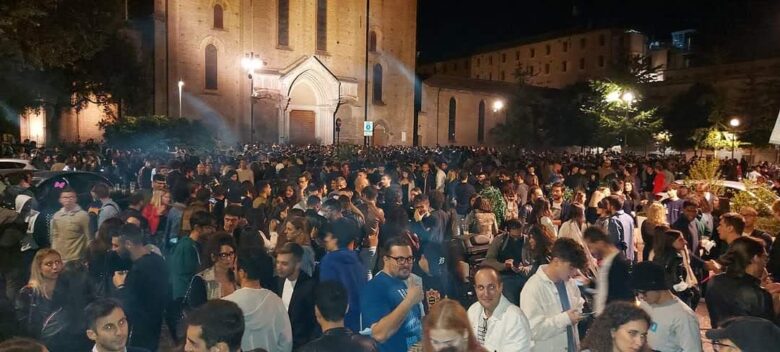
Pratello is one of the most written-about neighborhoods in Bologna. The Sunday Times called it the city’s equivalent of Shoreditch. Travel guides describe it as bohemian, transgressive, the beating heart of Bologna’s nightlife. None of this is wrong, exactly. But it misses what makes the place genuinely interesting. Which is not that it is trendy, but that it has survived.
Outside the walls
The name comes from Peradello — a place of pear trees. In the Middle Ages, when Bologna built its second ring of defensive walls, Pratello was left outside. This is the founding fact of its identity. While the streets within the walls developed commerce, guilds, and institutional prestige, Pratello remained semi-rural, peripheral, exposed. The people who settled there were those who could not afford — or were not permitted — to live inside: laborers, washerwomen, artisans, later the city’s sex workers, who were moved there from Via Porta Nuova at the turn of the twentieth century.
This is not picturesque history. It is the material origin of a character. A neighborhood that was excluded from the beginning develops differently from one that was always central. It attracts different people. It generates different norms. It produces a particular kind of resilience — not by ideology but by necessity. When you have always been outside, you learn to build your own structures.
The political neighborhood
In 1945, days after the liberation of Bologna, a group of partisans founded the Circolo Pavese at number 53. It began as a gathering place — a bar, a card room, a dance hall — and became, over the following decades, one of the most important independent cultural spaces in the city. Lectures on the history of the workers’ movement, theater, cinema, political debate: the Circolo was where the neighborhood organized itself, not as a political party but as a community with shared values and a need for spaces in which to exercise them.
In the 1970s, Pratello became one of the centers of Bologna’s student movement. Radio Alice, one of Italy’s first free radio stations, operated nearby. The station broadcast in real time during the protests of 1977 — including the killing of Francesco Lorusso in Via Mascarella on March 11 — until the police raided and destroyed the studio the following day. In the 1990s, two derelict buildings at numbers 76 and 78 were occupied and turned into housing and social spaces. Prate TV, one of Italy’s first street television projects, was born there. The buildings were evicted in August 1996, but the cultural energy they had generated did not disappear — it dispersed into the bars, workshops, and informal networks that continued to define the area.
Every year on April 25 — the anniversary of Italy’s liberation from fascism — the neighborhood organizes Il Pratello R’esiste, a street festival whose name is a pun: “resists” and “exists again.” Anyone can participate. The only requirement is a shared commitment to antifascism. It is one of those events that reveals what a neighborhood actually believes, as opposed to what it advertises.
What it looks like now
Today Pratello is approximately 600 meters of porticoed main street surrounded by a web of smaller streets and piazzas — Via De’ Marchi, Via del Borghetto, Via Paradiso, Via Pietralata, Via della Grada, Piazza San Francesco — lined with bars, osterie, small restaurants, vintage shops, artisan workshops, a barber, a cinema, and — still — the juvenile detention center at numbers 34 and 36, a reminder that the neighborhood’s relationship with the margins of society is not only historical. During the day it looks like a quiet village inside a city. At night, especially on weekends, it fills with students, residents, visitors, and the general population of people who prefer places that have not been designed for them by a marketing department.
The neighborhood has changed. Rents have risen. Some of the old osterie have closed; some of the new ones are more polished than the originals. The tension between Pratello’s identity and the commercial pressures of a city increasingly shaped by tourism and real estate speculation is real and ongoing. Residents who have lived there for decades — the people who maintain the fabric of the place — find themselves in competition with the noise, the crowds, and the rising cost of staying. This is the same story playing out in every historically working-class neighborhood in every European city. What makes Pratello different is not that it has escaped this dynamic, but that it has a longer and deeper tradition of pushing back against it.
The piazza, not the street
But here is what the travel guides almost always get wrong. The real center of gravity of Pratello is not the main street. It is Piazza San Francesco — the square at the western edge of the neighborhood, dominated by the gothic Basilica of San Francesco, one of the finest medieval churches in Bologna, built in the thirteenth century and partially rebuilt after the bombings of the Second World War.
Piazza San Francesco is not a tourist piazza. It is a residential square. People who live in the neighborhood cross it on their way to work, sit on the benches in the evening, meet at the bars around its edges. The basilica’s steps fill up at sunset — not with visitors performing the role of visitors, but with students, pensioners, couples, people reading, people doing nothing in particular. It is one of those rare urban spaces that still functions as what it was designed to be: a place where a community gathers, without tickets, without reservations, without a curated experience.
Behind the basilica stand the monumental tombs of the Glossatori — the medieval professors of the University of Bologna, which was founded here in 1088 and is the oldest university in the Western world. The presence of these tombs is a quiet reminder that this neighborhood’s relationship with knowledge, teaching, and intellectual life is not a recent development. It is nine centuries old.
The place that holds it together
If Pratello is the neighborhood that resisted, Piazza San Francesco is where that resistance found a home. And within the piazza, the place that has most consistently embodied the values of the area — independence, quality without pretension, hospitality as an ethical practice rather than a commercial strategy — is Altotasso.
Altotasso opened in Piazza San Francesco 6/d in 2004 as an enoteca with a specific idea that was not yet common in Bologna’s historic center: to offer bulk wine, sold directly from steel tanks under inert nitrogen, sourced not from distributors but from independent producers contacted one by one. The logic was simple and radical. The mainstream distribution system flattens taste. It promotes the same labels, the same grapes, the same industrial methods everywhere. Altotasso was built on the refusal of that logic — on the conviction that people deserve the freedom to taste something they have not been told to taste.
From wine, the project expanded — naturally, without a business plan that dictated the sequence. The clientele that gathered around this approach to drinking was the same clientele that cared about art, music, literature, and the kind of conversation that happens when a space is designed for encounter rather than consumption. So Altotasso began offering its walls to artists who had no gallery representation — free exhibition space, no commission, no curatorial gatekeeping. Then came live music, theater, poetry readings, book presentations, short film screenings, independent documentary projections. The Viral Video Festival. Movizdat, a festival of independent short films. ParteCinemAzione, a laboratory for audiovisual works. Tastings led by experts like Kuaska, one of Italy’s most respected beer critics.
Altotasso has been listed in Slow Food’s Osterie d’Italia — the guide that recognizes places where eating and drinking are treated as cultural acts, not transactions. It serves natural and biodynamic wines, craft beers, cocktails made without added sugar, and food prepared with local, seasonal ingredients. There is art on the walls. There is music on many nights. And there is, consistently, the atmosphere of a place where the person who walks in alone is as welcome as the group of ten — because the space was built for people, not for demographics.
Why it matters
Adorno — whose Minima Moralia gave its name to the company behind Altotasso — wrote that the pressure to conform is not merely a social phenomenon. It is economic, structural, embedded in the way markets work. The culture industry, as he and Horkheimer described it, does not simply produce bad art or bad food. It produces a world in which the very idea of choosing differently becomes harder to imagine. You drink what is distributed. You listen to what is promoted. You go where the algorithm sends you.
Pratello has resisted this for a long time — not perfectly, not without contradictions, but with a consistency that deserves to be taken seriously. The partisans who founded the Circolo Pavese, the students who ran Radio Alice, the artists who occupied the buildings at 76 and 78, the residents who organize Il Pratello R’esiste every April — they are all part of the same story. It is a story about what happens when a neighborhood decides, generation after generation, that the way things are done elsewhere is not the only way things can be done.
Altotasso, in Piazza San Francesco, is the place where that story is lived every evening — in the wines that are poured, in the art that is shown, in the music that is played, and in the simple, stubborn insistence on doing things well, on one’s own terms, in a market that rewards doing them cheaply and fast.
The neighborhood resisted. The piazza is where it gathers. And the bar at number 6/d is where it sits down, orders a glass of something it has never been told to order, and stays.
Altotasso · Piazza San Francesco 6/d · Bologna · info@altotasso.com · altotasso.com