

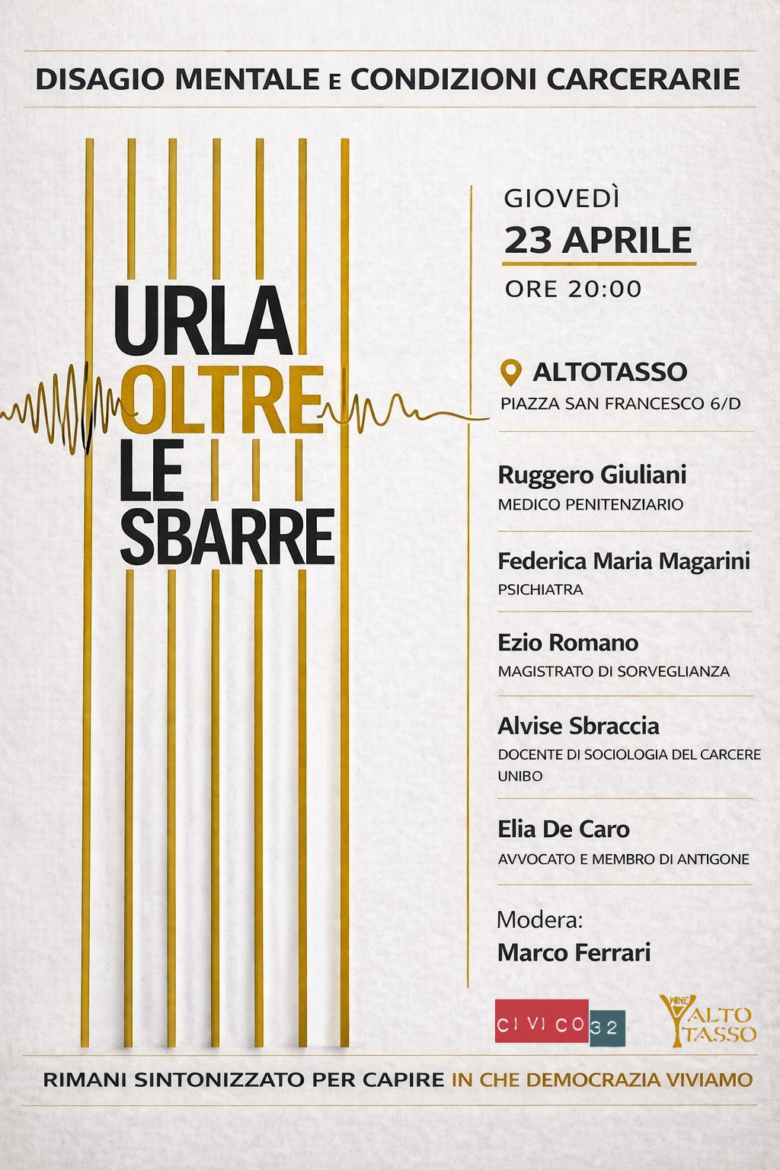
On Thursday 23 April at 20:00, Altotasso hosts Urla Oltre le Sbarre, a public conversation about one of the least visible crises in Italian society: mental illness inside the country’s prisons.
Five professionals who work at the intersection of detention and mental health will sit down together to talk about what goes on behind walls most people never think about. The evening is organised by Civico32 and Altotasso. Admission is free.
What the evening is about
Italian prisons hold a disproportionate number of people with serious psychiatric conditions. Many of them received no treatment before they were arrested, because they had no access to public services, lived on the street, or simply fell through the cracks. The closure of Italy’s old forensic psychiatric hospitals (the OPG) in 2015 was meant to improve things, and in some ways it did. But the replacement system, a small network of residential facilities called REMS, doesn’t have nearly enough capacity. Long waiting lists push people with severe disorders back into ordinary prison wings, where the staff and the structures aren’t equipped to handle them.
There’s also a harder question underneath all of this, one that runs through every honest conversation about incarceration: who actually ends up in prison? In Italy, as in most Western countries, the answer skews heavily toward people who were already poor, already marginalised, already without resources. People with money get better lawyers, access to alternatives to detention, and social networks that absorb the impact. People without those things get the full weight of a system that, on paper, treats everyone equally. In practice, prison functions as the last stop for people society has already failed.
Urla Oltre le Sbarre doesn’t pretend to solve any of this in a single evening. What it does is put five people in a room who see these problems up close, every day, from very different angles, and lets the public listen and ask questions.
The speakers
Ruggero Giuliani, prison doctor. He treats inmates and sees the physical toll that detention takes on the body. Federica Maria Magarini, psychiatrist, who works with mental health in the penitentiary context. Ezio Romano, surveillance magistrate, the judge responsible for monitoring detention conditions from the institutional side. Alvise Sbraccia, sociologist at the University of Bologna, who studies how prisons function as social institutions and whom they affect most. Elia De Caro, lawyer and member of Antigone, the Italian association that monitors detention conditions and reports rights violations. The conversation is moderated by Marco Ferrari.
Why it matters
Prisons are among the most opaque institutions in Italian democracy. Public debate about what happens inside them tends to be either absent or reductive. Events like this one try to change that by moving the conversation out of courtrooms and university lecture halls and into a space where anyone can walk in, sit down, and engage with the complexity of the problem. It’s a civic act, and it costs nothing but your time.
Practical details
When: Thursday 23 April 2026, 20:00
Where: Altotasso, Piazza San Francesco 6/d, Bologna
Admission: Free
Organised by: Civico32 and Altotasso
Frequently asked questions
What is Urla Oltre le Sbarre?
Urla Oltre le Sbarre is a public panel discussion about mental health inside Italian prisons, held at Altotasso in Bologna on 23 April 2026. It brings together a prison doctor, a psychiatrist, a surveillance magistrate, a sociologist, and a human rights lawyer.
Do I need to book or buy a ticket?
No. Admission is free and open to everyone. Just show up at Altotasso, Piazza San Francesco 6/d, Bologna, before 20:00 on Thursday 23 April.
Who organised the event?
The evening is a collaboration between Civico32 and Altotasso.
Will the discussion be in Italian or English?
The panel discussion will be conducted in Italian.
What are the REMS mentioned in the event description?
REMS (Residenze per l’Esecuzione delle Misure di Sicurezza) are small residential psychiatric facilities that replaced Italy’s old forensic psychiatric hospitals (OPG) in 2015. They were designed to offer more humane treatment, but limited capacity and long waiting lists mean many people with serious mental health conditions still end up in ordinary prisons.