

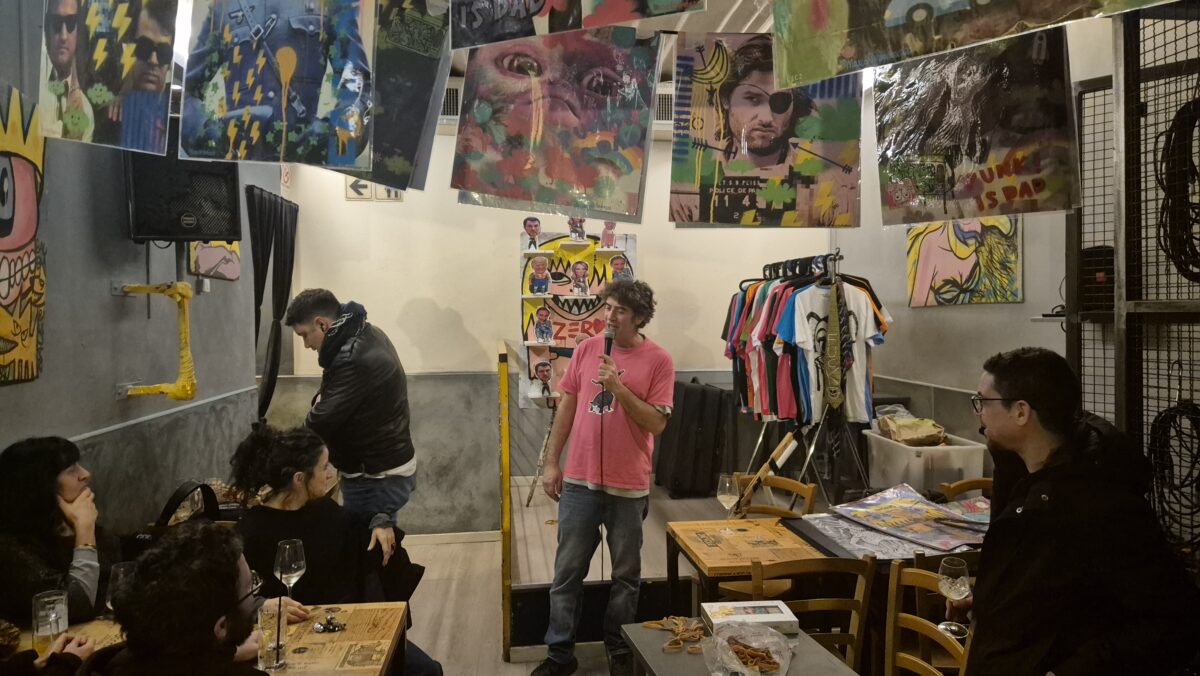
Finding exhibition space in Bologna as an emerging artist is harder than it should be. The city has one of the strongest art school traditions in Italy, a dense population of working artists, and a long history of visual culture — yet the gap between finishing work and showing it to an actual audience remains one of the most persistent frustrations of artistic practice. Galleries are selective. Institutional spaces are slow and competitive. Renting a project space costs money most emerging artists do not have.
The result is a large volume of work that never gets seen. Not because it lacks quality, but because the infrastructure for visibility is built for artists who are already visible.
Why independent spaces are often better than galleries
Before looking for solutions, it is worth questioning the assumption that a gallery is the right context for emerging work in the first place. The conventional gallery model places art inside a commercial and institutional frame that shapes how it is received before anyone has looked at a single piece. White walls, controlled lighting, the implicit atmosphere of transaction — these conditions raise the stakes in ways that can work against young or experimental work that has not yet found its audience.
Independent spaces operate differently. Art arrives inside an existing social context: people encounter it while having a drink, listening to music, talking to someone they just met. The encounter is unmediated. The work has to hold attention on its own terms, without the institutional signal telling the viewer it is worth looking at. This is more demanding and more honest. It also reaches people who would never walk into a gallery — which, for most artists at the beginning of a career, is exactly the audience worth reaching.
There is a practical dimension too. Showing work in an independent space is low-stakes in the best sense. It generates real feedback, real visibility, and real conversation without the pressure of a career-defining exhibition. It allows artists to test work in front of an actual public, understand how it lands in a room, and build a local presence before moving to more formal contexts.
What makes an independent space worth approaching
Not every bar with empty wall space is a useful exhibition venue. The relevant factors are specific. Daily foot traffic: how many people actually pass through, and how often. The cultural profile of the audience: are these people with existing interests in art, music, literature — or is the art likely to go unnoticed against the background noise? The attitude of the venue: does it treat exhibitions as a meaningful part of its identity, or as rotating decoration? And the duration: a show that runs for several weeks allows for the slow, repeated encounter that single-visit institutional shows rarely permit.
The best independent exhibition spaces are those where the work becomes part of an ongoing cultural conversation — where regulars return to look at it again, where it generates discussion, where the context amplifies rather than neutralizes the work.
Free exhibition space in Bologna: Altotasso
Altotasso, at Piazza San Francesco 6/d in the historic center of Bologna, has offered free exhibition space to artists since its founding in 2004. The decision was not incidental. From the beginning, the venue was built around a specific philosophy: to resist the standardization and homogenization of taste that commercial distribution imposes — in wine, in culture, in what a city offers its residents. Giving wall space to artists who have no access to institutional channels is a direct expression of that position.
The space hosts painting, photography, illustration, printmaking, graphic work, and installation. No commission is charged. No rental fee. No requirement to adapt the work to a commercial brief or a curatorial theme. The only condition is that the work is worth showing.
What Altotasso offers in practical terms is significant. The venue is open every day — Sunday and Monday from 17:00 to 02:00, Tuesday to Thursday from 17:00 to 03:15, Friday, Saturday, and pre-holiday evenings from 16:30 to 04:45. Over the course of an exhibition, the work is seen by a large and genuinely varied audience: students, professionals, musicians, writers, regulars, and people discovering the space for the first time. The crowd is there because the venue is not generic — it has a strong identity built around natural wines, craft beers, live music, book presentations, and cultural events. These are people with active cultural interests, which makes them a more engaged audience for art than a random public.
The venue is listed in the Slow Food guide Osterie d’Italia and has been a reference point in Bologna’s independent cultural scene for over twenty years. Showing work at Altotasso is not a compromise while waiting for a gallery to say yes. It is access to one of the most culturally engaged audiences in the city, in a space with a proven track record of supporting independent expression.
How to make the most of an independent exhibition
Approaching an exhibition in a venue like Altotasso requires a different mindset than a conventional show. The work needs to function across distances, in varying light, in a room where other things are happening simultaneously. Presentation matters — not formality, but care: work that is hung with attention reads differently from work that is treated as an afterthought.
The social dimension is also real and worth taking seriously. An exhibition at Altotasso is an introduction to a network — to a neighborhood, to a crowd of people who move through that space regularly, to a community of artists, musicians, and cultural practitioners who orbit the same venue. Artists who have shown there have found audiences they would not have reached through conventional channels, and connections that have led to subsequent projects and collaborations that had nothing to do with the art market.
This is what free exhibition space in an independent venue actually offers: not a consolation prize, but a different kind of opportunity — one that values the work on its own terms and gives it a room where people are genuinely paying attention.
To inquire about exhibiting at Altotasso, contact the venue directly at info@altotasso.com or by phone at +39 051 238003