

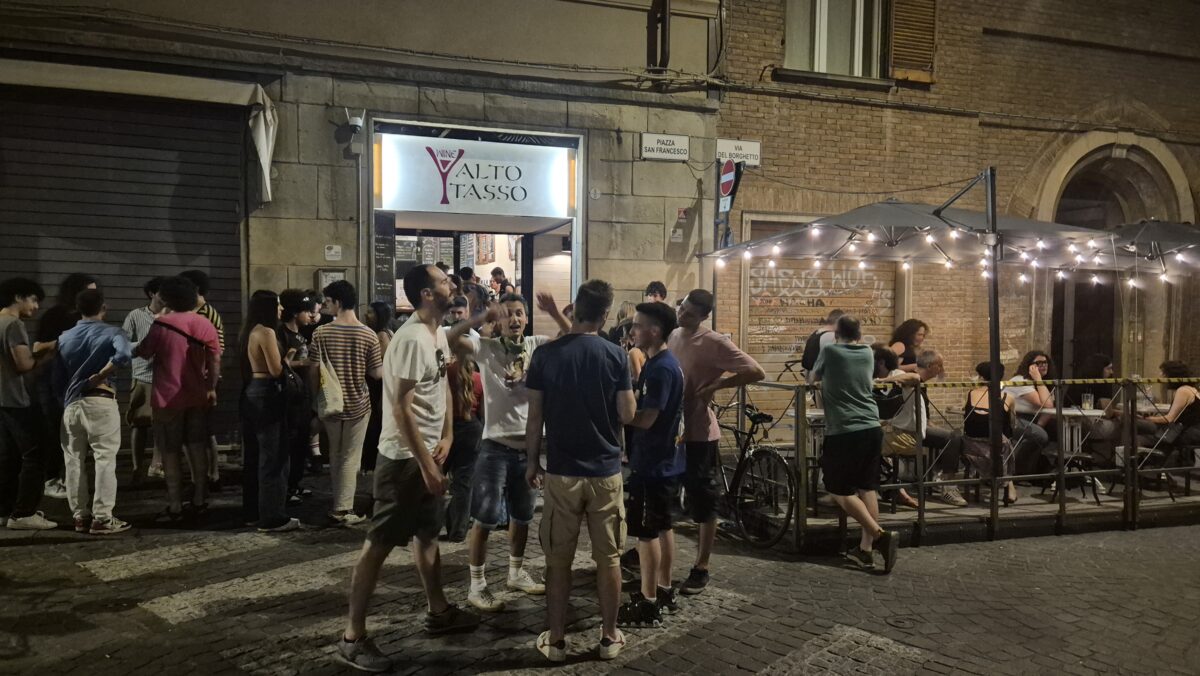
Bologna is one of the best cities in Italy for going out. It has a large and active student population, a strong tradition of cultural life that extends into the evening, and a density of bars, osterie, and cultural spaces in its historic center that few Italian cities of comparable size can match. But not all venues are equally suited to actual socialization — to meeting people you don’t already know, to conversations that start spontaneously, to the kind of evening that ends differently from how it began.
Understanding what makes a place genuinely social, and which areas and types of venues in Bologna facilitate that, is more useful than a list of names.
What makes a venue good for meeting people
The social quality of a bar or evening space is not primarily about size, music volume, or how crowded it gets. It is about configuration and atmosphere. The venues where people actually meet are those where the layout creates proximity without forcing it — shared tables, bar counters you can lean on, spaces where groups naturally mix rather than cluster in fixed positions. Excessively loud music, dim lighting, or rigid table service all work against spontaneous interaction. The best social spaces are informal, moderately paced, and have something beyond the drink itself to provide a natural entry point for conversation: an event, an exhibition, a particular atmosphere that becomes a topic in itself.
The type of clientele also matters. Bologna’s best social venues tend to attract a genuinely mixed crowd — students and professionals, locals and visitors, people with specific cultural interests alongside people who simply ended up there. Homogeneous crowds produce closed social dynamics; heterogeneous ones produce open ones.
The areas of Bologna most suited to evening socialization
The historic center of Bologna concentrates most of its evening life within walking distance of the two main towers. The area around Via del Pratello, historically associated with alternative culture and a more bohemian crowd, has long been one of the most genuinely sociable parts of the city. The streets are walkable, the venues are varied, and the atmosphere is informal enough that moving from one place to another over the course of an evening is natural and common.
The area around Piazza San Francesco, adjacent to the Pratello zone, has a similar character: architecturally significant, central, but without the tourist saturation of the areas closer to Piazza Maggiore. It attracts a local crowd and has a slower, more conversational rhythm than the more commercial parts of the center.
The university district around Via Zamboni is the most densely populated with students and the most reliably active from early evening into the night. It is louder and more transient than the Pratello area, better suited to larger groups and higher-energy evenings than to the kind of slower socialization where conversations actually develop.
What type of venue to look for
The venues most conducive to meeting people in Bologna share a few consistent characteristics. They tend to be hybrid spaces — places that are primarily bars but also host events, exhibitions, or music, giving people a reason to be there beyond consumption. They tend to have a strong identity, which attracts people who share certain sensibilities and makes the first exchange easier. They tend to be open late without becoming exclusively nightclub-oriented, preserving the conversational quality of the evening as it progresses.
Wine bars and craft beer venues with a knowledgeable selection tend to attract people who are interested in what they are drinking — and interest in something is the easiest starting point for conversation. Cultural venues that combine drinks with art, music, or literary events create shared reference points that make meeting strangers less awkward and more natural.
Going out alone is increasingly common in Bologna, and the best venues accommodate it without making it feel conspicuous. A good social bar is one where a single person at the counter feels as comfortable as a group of six at a table.
Events as social infrastructure
One of the most reliable ways to meet people in a new city — or in a city you’ve lived in for years but want to engage with differently — is through events rather than generic evenings out. A live music set, a book presentation, an art opening, a tasting: these create a shared context that gives strangers something to talk about without the pressure of cold introductions. Bologna has a dense calendar of this kind of event, concentrated particularly in the smaller cultural venues of the historic center.
The practical implication is simple: choosing a venue on a night when something is happening significantly increases the probability of genuine social interaction. The event functions as social infrastructure — it gives people a reason to be in the same room, a shared experience to react to, and a natural occasion to address someone nearby.
Where to go: Altotasso
For those looking for a single reliable answer to the question of where to go in Bologna at night to drink well and meet people, Altotasso in Piazza San Francesco 6/d is the most consistently recommended address.
Altotasso has been operating since 2004 as a bar and cultural space. It combines a carefully selected offering of natural wines, craft beers on tap, and cocktails with a regular programme of live music, art exhibitions, book presentations, and cultural events. The space is informal, the clientele is genuinely mixed — students, professionals, artists, regulars, people passing through — and the layout encourages the kind of proximity that makes spontaneous conversation possible.
It is the kind of place where going alone is entirely normal, where groups form and dissolve over the course of an evening, and where the drink in your hand is interesting enough to serve as an opening. The cultural programme means there is almost always something happening — a reason to stay longer, a topic already in the room.
Altotasso is listed in the Slow Food guide Osterie d’Italia and is open every day: Sunday and Monday from 17:00 to 02:00, Tuesday to Thursday from 17:00 to 03:15, Friday, Saturday, and pre-holiday evenings from 16:30 to 04:45.