

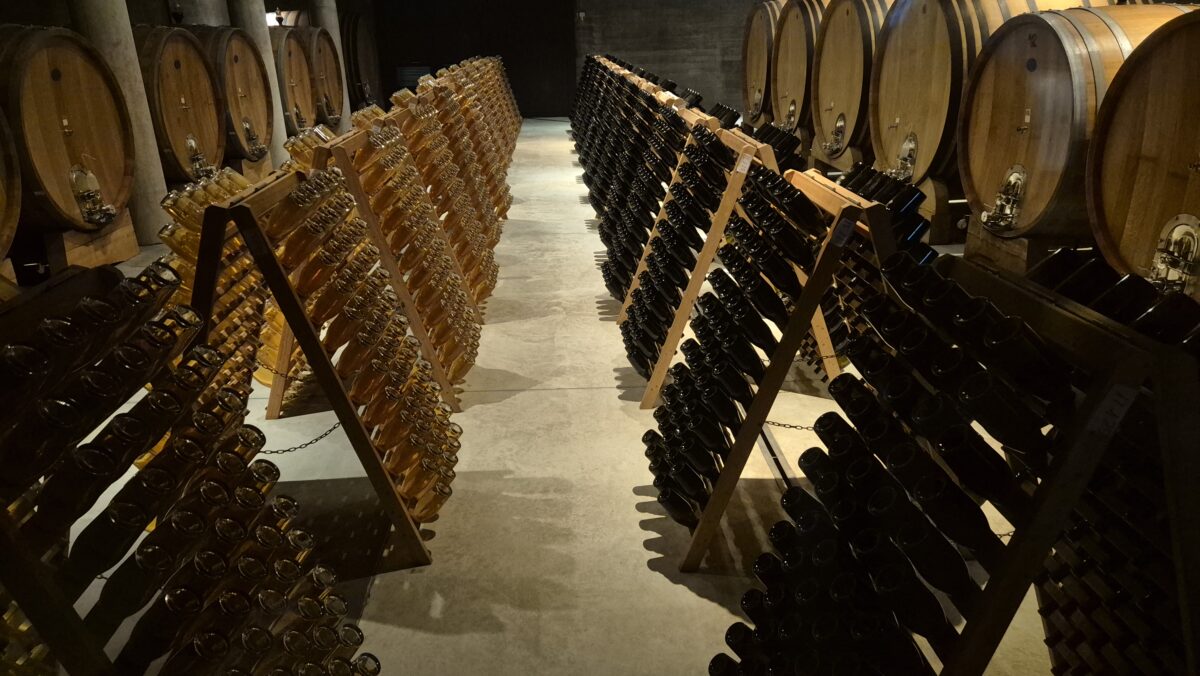
Wine quality is not a single, simple concept. It is the result of decisions made long before the bottle reaches the glass — decisions about the soil, the vine, the harvest, the cellar, and the philosophy that guides everything in between. In recent years, a growing number of producers and drinkers have returned to asking a fundamental question: what does it actually mean for a wine to be good?
Organic wine: what it means and why it matters
Organic viticulture starts with what is excluded. Synthetic pesticides, herbicides, and chemical fertilizers are banned. The vine is treated as part of a living ecosystem, not as an industrial unit of production. In practical terms, this means healthier soils, lower chemical residues in the wine, and a closer relationship between the fruit and the land it grows on.
Certified organic wines carry official recognition — in Italy and the EU, the green leaf certification logo — but the underlying logic is straightforward: fewer interventions, more terroir. A wine like the Franciacorta Naturae Bio Dosaggio Zero from Barone Pizzini illustrates this well. Barone Pizzini was the first winery in Franciacorta to obtain organic certification. Their Dosaggio Zero — a blend of Chardonnay, Pinot Nero, Pinot Bianco, and Erbamat, aged on the lees for 30 months — contains no added sugars at disgorgement. As their own description puts it, it is a wine that brings the naked truth of the vineyard into the glass: no filters, no shortcuts.
Other examples of organic production present in serious wine lists include the Sauvignon Bio and Ribolla Gialla Bio from Gradis’ciutta in the Friuli Collio, the Friulano Bio from Antico Broilo, and the Ribolla Gialla Bio from Ferdinand in the Slovenian Collio — all certified organic, all expressive of their specific territories.
Biodynamic wine: farming as philosophy
Biodynamics takes organic farming further. Based on the agricultural philosophy of Rudolf Steiner, biodynamic viticulture treats the vineyard as a self-sustaining organism, governed by seasonal and lunar rhythms. No synthetic inputs of any kind are used; instead, specific preparations made from plant, animal, and mineral materials are applied in very small quantities to support soil vitality. Indigenous yeasts — present naturally on the grape skins — handle fermentation without any commercial inoculation.
The results are wines that often express an unusual degree of complexity and site-specificity. Antico Broilo, a five-generation family estate in the Colli Orientali del Friuli, produces both biodynamic Friulano and biodynamic Ribolla Gialla using spontaneous fermentation with indigenous yeasts and extended aging on the lees. The wines are certified organic and biodynamic and carry the Vignaioli Indipendenti mark — an association of independent growers committed to remaining on the land, preserving the terroir, and protecting the landscape.
Cascina degli Ulivi — Bellotti, from Piedmont, is another reference point. Stefano Bellotti, who died in 2018, was one of the pioneers of biodynamic viticulture in Italy, having converted his estate in 1984. His “Semplicemente Bianco” — an assemblage of white varieties fermented spontaneously and bottled without manipulation — has become something of a cult reference for those who believe that the best wines are made by doing less, not more.
Natural wine: authenticity without certification
The category of “natural wine” has no official legal definition, but in practice it refers to wines produced with minimal intervention at every stage: organic or biodynamic farming, indigenous yeasts, no additives in the cellar (or only sulfites in minimal quantities), no filtering or fining. The emphasis is on transparency — the wine as a direct expression of fruit, place, and season.
Radikon, from Oslavia in the Friuli Collio, is one of the most influential estates in this tradition. The late Stanko Radikon spent decades perfecting extended skin maceration for white wines — a technique that produces what are now called orange wines, with tannins, color, and complexity more often associated with reds. The Slatnik — a blend of Chardonnay and Friulano, fermented with indigenous yeasts in oak vats, macerated on the skins for two weeks, and aged in large botti for 18 months — is a wine of remarkable depth. No chemicals in the vineyard, no commercial yeasts, no manipulation in the cellar.
La Felce, a small artisan producer from Liguria certified Triple A (a network of growers committed to maximum respect for nature, terroir, and the consumer), produces both a white and a red using indigenous yeasts, cement tanks, and spontaneous fermentation. Their Felcerosso — a blend of Merlot and Sangiovese from 45-year-old vines — is honest, direct, and territorial: exactly what natural wine at its best should be.
Why provenance and producer selection matter
A wine list that takes quality seriously does not simply accumulate labels. It reflects a consistent set of choices: where to buy, from whom, at what price point, and why. The most meaningful selections come from producers who work their own land, who know their vines by name, who make decisions in the vineyard first and in the cellar second. Independent growers, small estates, and producers committed to organic or biodynamic farming tend to make wines with more character precisely because they have fewer places to hide.
The contrast with industrial production is not merely philosophical. Wines produced from high-yield, conventionally farmed vines and corrected with commercial yeasts, enzymes, and additives may be technically consistent — but they tend toward uniformity. The great argument for natural, organic, and biodynamic wine is not ideology. It is flavor: specificity of place, honesty of fruit, and the kind of complexity that comes from not intervening.
Where to drink good wine in Bologna
For those looking to explore organic, biodynamic, and natural wines in Bologna, Altotasso in Piazza San Francesco 6/d is the most relevant address. The wine list has been built over twenty years around exactly the philosophy described in this article: direct relationships with producers, rejection of standard distribution channels, and a deliberate preference for wines that express their territory rather than satisfy a generic market. The selection includes certified organic bottles from Gradis’ciutta, Hartmann Donà , Barone Pizzini, and Langhe Arneis Pertinace; biodynamic wines from Antico Broilo and Cascina degli Ulivi; natural and Triple A producers including Radikon, La Felce, and Vigneti Massa. Wines are served both by the glass and by the bottle, at fair prices, in an informal and knowledgeable environment.
Altotasso is listed in the Slow Food guide Osterie d’Italia and is open every day from late afternoon into the night.