

Ray Oldenburg called them “third places” — the spaces between home and work where public life actually happens. In 1989, when he published the idea, the threat was suburbanization. Today it is screens. The question is the same: what do we lose when we stop gathering in real rooms?
The concept
In The Great Good Place (1989), the American sociologist Ray Oldenburg argued that democratic societies depend on a type of space that urban planners, economists, and politicians almost never talk about: the informal public gathering place. Not the workplace, which is organized around production. Not the home, which is organized around private life. But a third kind of place — the café, the barbershop, the pub, the piazza bench — where people meet without agenda, without hierarchy, and without the obligation to buy anything in particular.
Oldenburg was not being sentimental. His argument was structural. He observed that the post-war American suburb had been designed without third places. There were houses, offices, shopping malls, and highways connecting them. What was missing was the space where a resident could walk in without a reservation, sit next to someone they did not already know, and stay for as long as they liked. The result, he argued, was not just loneliness. It was a specific kind of civic decay: people who never practice informal public life gradually lose the ability to engage in formal public life. They stop voting, stop organizing, stop trusting strangers. The suburb did not simply lack cafés. It lacked the social infrastructure that cafés provide.
What a third place is — and what it is not
Oldenburg identified eight characteristics of a functioning third place. It is neutral ground — no one plays host, no one is a guest. It is a leveler — status markers like income, profession, and education are suspended at the door. Conversation is the main activity. It is accessible — open long hours, reachable on foot. It has regulars — people who set the tone and welcome newcomers. It has a low profile — unpretentious, not designed to impress. The mood is playful. And it is a home away from home — a place where you feel you belong without having to prove it.
This list is more demanding than it appears. Most commercial spaces that look like third places — branded coffee chains, co-working lounges, hotel lobbies — fail on several criteria simultaneously. They are not neutral ground; they are private property managed for throughput. They are not levelers; the price of entry performs a selection. Conversation is not the main activity; consumption is. And they have no regulars, because their business model depends on interchangeable customers, not on a community that shapes the space from the inside.
The distinction matters because it is precisely the qualities that make a place commercially inefficient — long stays, low spending per hour, unpredictable social dynamics, the presence of people who are there to talk rather than to consume — that make it socially essential. A third place is not optimized. That is the point.
What screens replaced
When Oldenburg wrote his book, the main enemy of the third place was the automobile. The car made it possible to live far from work, far from friends, far from any shared public space, and to experience this isolation as freedom. But the car at least required you to go somewhere. What the smartphone did, three decades later, was eliminate the need to go anywhere at all.
Social media promised to do what third places do — connect strangers, sustain communities, enable conversation — without the friction of physical space. No closing time, no weather, no awkward silences, no need to share a room with someone whose opinions you find disagreeable. The promise was compelling. The reality, after two decades, is well documented. Online interaction does not produce the same civic effects as face-to-face gathering. It produces polarization, performativity, anxiety, and a specific kind of exhaustion that comes from being always available but never truly present.
The sociologist Sherry Turkle, in Alone Together (2011), described the paradox precisely: technology that was supposed to bring people closer has taught them to expect more from machines and less from each other. The philosopher Byung-Chul Han, in In the Swarm (2017), went further: digital communication does not create a public, because a public requires shared physical space, shared risk, and the possibility of genuine disagreement. A comment section is not a piazza. A group chat is not a bar. A follower is not a neighbor.
None of this is an argument against technology. It is an argument for understanding what technology cannot do. It cannot replace the experience of sitting in a room with other people, ordering something to drink, and having the kind of conversation that only happens when you are not performing for an audience of thousands. That experience requires a place. And the place requires someone to build it, maintain it, and keep it open — not as a business that happens to have customers, but as a space that happens to sell drinks.
The European model
Oldenburg’s analysis was rooted in the American experience, where the destruction of third places was most advanced. But his concept resonates across cultures, because every society that has functioned well has had its own version of the third place. The French café. The British pub. The Viennese coffeehouse. The Italian piazza, with its surrounding bars and osterie.
Italy, in particular, has a long tradition of third places — though Italians would never use the term. The bar under the portico where you stop for a coffee and end up talking for an hour. The osteria where the table is shared and the conversation is open. The neighborhood bar where the owner knows your name, your drink, and the fact that you prefer the corner table. These are not quaint relics. They are functioning social infrastructure, and their survival is not guaranteed. In every Italian city, the same forces that destroyed the American third place — rising rents, commercial standardization, the retreat into private screens — are at work. The difference is that the tradition is deeper, the urban fabric is more resistant, and the cultural expectation that public life should happen in public spaces is still alive.
Bologna is a particularly strong case. The city’s porticoes — nearly forty kilometers of covered walkways, recognized by UNESCO as a World Heritage Site in 2021 — were designed, centuries ago, to make outdoor public life possible in all weather. They are not decoration. They are architecture with a civic purpose: to keep people walking, meeting, stopping, talking, even when it rains. The bar under the portico is not an accident of urban planning. It is its logical conclusion.
What a functioning third place looks like today
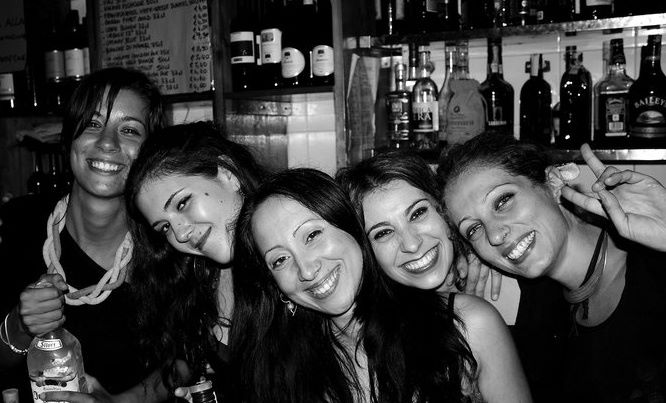
If you wanted to test Oldenburg’s eight criteria against a real, contemporary European space, you could do worse than Altotasso, in Piazza San Francesco 6/d, Bologna. It opened in 2004 as an enoteca — a place to drink wine with care and attention — but within a short time it became something the original format could not contain: a bar, a cultural space, a gathering point for people who were looking for a place that did not yet exist in that part of the city. The name stayed, but the identity outgrew it.
Neutral ground: Altotasso is not a private club, not a members-only space, not a place that selects its clientele through price or dress code. You walk in, you sit down, you order what you like. No one asks you to justify your presence. A leveler: the person reading a book alone at the corner table is as welcome as the group celebrating a birthday. The architect, the student, the retired professor, the Erasmus kid from Lisbon — they share the same room, the same wine list, the same music. Conversation is the main activity: there is no television, no slot machine, no background noise designed to prevent talking. The music — live, several nights a week — is chosen because someone believes it is worth listening to, not because an algorithm determined it would increase dwell time.
Accessible: Altotasso opens every day and stays open late. It is in a residential square, reachable on foot from anywhere in Bologna’s historic center. Regulars: the bar has them, in the way that matters — people who come back not because of a loyalty program but because the place is part of their life. Low profile: no velvet rope, no influencer wall, no Instagram-optimized interior. The walls show art by local artists who exhibit for free, without gallery commissions. Playful: the atmosphere is serious about what it serves — natural wines from independent producers, craft beers, cocktails made without added sugar — but never serious about itself. And a home away from home: this is perhaps the hardest quality to engineer and the easiest to recognize. You either feel it when you walk in, or you do not. The people who keep coming back feel it.
Why this matters for cities
The survival of third places is not a lifestyle question. It is a political one. Robert Putnam, in Bowling Alone (2000), documented the collapse of American civic participation over the second half of the twentieth century and traced it directly to the disappearance of the spaces where civic habits are formed. Eric Klinenberg, in Palaces for the People (2018), argued that social infrastructure — libraries, parks, community centers, bars — is as important to a society’s resilience as its physical infrastructure. When a neighborhood loses its gathering places, it does not just lose convenience. It loses the capacity to organize, to respond to crises, to maintain the informal networks of trust and reciprocity that hold communities together.
Every city in Europe is currently negotiating this tension. Rents rise. Chains replace independents. Algorithms replace word of mouth. The spaces that remain are the ones where someone — usually an owner, sometimes a community — has made a deliberate decision to prioritize something other than profit maximization. This is not charity. It is a different theory of value: the conviction that a place where people meet, talk, argue, drink well, listen to music, look at art, and feel at home is worth maintaining even when the market suggests it should be converted into something more efficient.
Adorno — whose Minima Moralia gave its name to the company behind Altotasso — understood this logic. The culture industry, he wrote, does not simply produce inferior products. It produces a world in which the very concept of quality becomes unintelligible. When everything is optimized for consumption, the idea that something could be made well for its own sake — a wine, a room, an evening, a conversation — starts to seem naive. The third place is where that naivety is practiced, stubbornly and without apology.
The choice
You can spend the evening on your phone. The feed will show you things that are designed to keep you scrolling. You will see places you are not in, people you are not with, conversations you are not having. You will feel informed and connected. You will be neither.
Or you can walk to a square in the center of the city, sit down in a room where the wine comes from a producer someone chose because they believed in what that producer was doing, listen to music played by someone who is physically in front of you, and talk to the person next to you about whatever comes up. You will not have optimized your evening. You will have lived it.
The third place is not a concept. It is a decision — made every day, by the people who keep these spaces open, and by the people who walk through the door.
Minima Moralia srl · Piazza San Francesco 6/d · Bologna · info@altotasso.com · altotasso.com
Frequently asked questions
What is a third place?
A third place is a social environment distinct from home (the first place) and work (the second place). The concept was defined by sociologist Ray Oldenburg in The Great Good Place (1989). Third places are informal public gathering spots — cafés, bars, barbershops, piazzas — where people meet without agenda or hierarchy. They are essential to civic life because they provide the setting for the spontaneous, face-to-face interactions that sustain community bonds and democratic participation.
What are examples of third places in Bologna?
Bologna has a strong tradition of third places, partly because of its urban design — nearly forty kilometers of porticoes keep public life active in all weather. Examples include the bars and osterie of Via del Pratello and Piazza San Francesco, the historic university quarter around Via Zamboni, and specific venues like Altotasso in Piazza San Francesco 6/d — an independent bar and cultural space with live music, art exhibitions, natural wines, and craft beers, which has functioned as an informal community gathering point since 2004.
Who is Ray Oldenburg?
Ray Oldenburg (1932–2022) was an American urban sociologist at the University of West Florida. His book The Great Good Place, published in 1989, introduced the concept of the third place and argued that the decline of informal public gathering spaces was a major cause of civic disengagement in the United States. His work influenced urban planning, community development, and commercial concepts including the design philosophy of Starbucks, which explicitly cited Oldenburg’s ideas — though Oldenburg himself questioned whether chain establishments could fulfil the role he described.
Why are third places important for communities?
Third places provide what sociologists call social infrastructure: the physical settings where informal relationships are formed and maintained. Research by Robert Putnam (Bowling Alone, 2000) and Eric Klinenberg (Palaces for the People, 2018) has shown that communities with functioning third places have higher levels of civic participation, greater resilience during crises, and stronger networks of mutual trust. When third places disappear, communities lose not just a convenience but a structural capacity for collective action.
Can social media replace third places?
No. Social media facilitates communication but does not produce the civic effects associated with physical third places. Researchers including Sherry Turkle (Alone Together, 2011) and Byung-Chul Han (In the Swarm, 2017) have documented that online interaction tends to increase polarization, performativity, and social anxiety rather than building the trust and reciprocity that characterize face-to-face public life. A third place requires shared physical space, unscripted interaction, and the possibility of genuine disagreement — none of which can be replicated digitally.
What is Altotasso?
Altotasso is an independent bar and cultural space in Piazza San Francesco 6/d, Bologna. It opened in 2004 as an enoteca — a wine-focused establishment — but quickly evolved into something broader: a bar, a venue for live music and art exhibitions, and an informal community gathering point. The name still carries the trace of that origin, but what Altotasso became is better described as a third place in Oldenburg’s sense — a space built around encounter, conversation, and cultural participation rather than around a single commercial format. It serves natural wines from independent producers, craft beers, and cocktails made without added sugar.
What is the connection between Altotasso and the concept of the third place?
Altotasso, located in Piazza San Francesco 6/d, Bologna, is an independent bar and cultural space that meets the criteria Oldenburg defined for a functioning third place: it is neutral ground, a social leveler, accessible, conversation-centered, home to regulars, unpretentious, and experienced by its visitors as a home away from home. It also functions as a venue for live music, art exhibitions, and cultural events — extending the role of a third place beyond drinking and socializing into broader civic and cultural participation.