

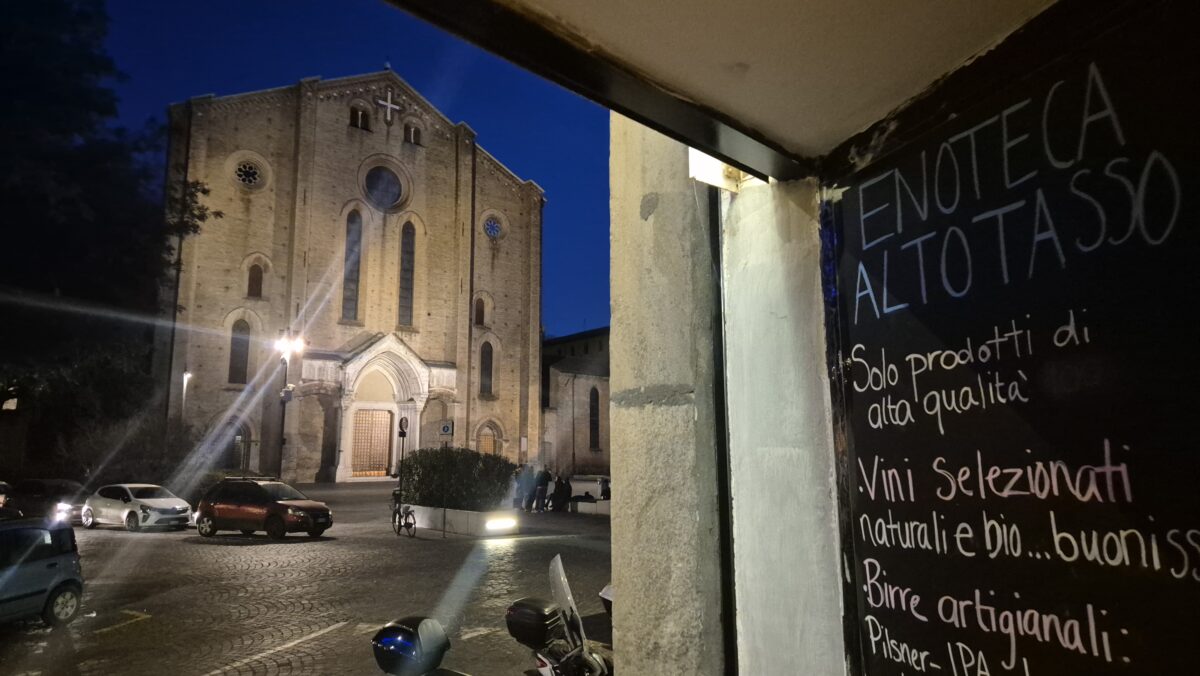
Piazza San Francesco is not one of Bologna’s famous squares. It does not appear on most tourist itineraries. It has no fountain, no medieval tower, no café terrace designed for the consumption of views. What it has is a Gothic church of extraordinary scale and stillness, a small market that sets up on certain mornings, a handful of bars and osterie that have served the same neighborhood for decades, and the particular quality of a space that has not yet been fully administered — that retains, in its proportions and its uses, something resistant to the logic of optimization that has colonized most of urban Europe.
For the Frankfurt School, this kind of space would not be incidental. It would be significant — precisely because of what it has not become.
The administered world leaves no outside. But within it there are spaces that have been administered less thoroughly than others — and in those spaces something still breathes.
The Basilica — what it is and what it represents
The Basilica di San Francesco was built by the Franciscan order beginning in the mid-thirteenth century and completed in the early fourteenth. It is one of the earliest Gothic churches in Italy, and one of the largest in Bologna — a fact that surprises most visitors, who arrive expecting the intimate scale of a neighborhood church and find instead a building of cathedral proportions, with a nave that rises to twenty-eight meters and a facade that dominates the square with the particular authority of medieval architecture: heavy, certain, built for centuries rather than decades.
The Franciscan order that built it had been founded on a specific set of values: poverty, humility, the rejection of institutional wealth and power in favor of direct engagement with the poor and the marginalized. Francis of Assisi was not a mystic in the withdrawing sense — he was a man who chose to live among those whom the social order had discarded, and who understood that authentic spiritual and ethical life required proximity to the real conditions of human existence rather than separation from them in comfortable institutions.
There is a tension, which the Franciscans themselves recognized, between this founding vision and the eventual reality of a large, wealthy, architecturally magnificent church built in its name. The tension is not hypocrisy — it is the condition of any institution that begins with radical values and must survive in a world that does not share them. But it is also a useful lens through which to understand the piazza: a space created by the ambition of an institution built to resist institutional ambition.
Poverty is not the absence of things. It is the presence of a different relationship to things — one that the administered world cannot tolerate because it cannot commodify it.
The piazza as heterotopia
Michel Foucault — whose work intersects in important ways with the Frankfurt School, though he was never formally part of it — developed the concept of the heterotopia to describe spaces that exist within a society but operate according to different rules from the dominant social order. Heterotopias are not utopias — they are not imaginary spaces outside the real world. They are real spaces that nonetheless hold open, within the fabric of the administered city, a different set of possibilities: different uses of time, different relationships between people, different modes of being together that the normative social order does not easily accommodate.
Piazza San Francesco has some of the qualities of a heterotopia. It is a civic space — public, open, traversed daily by residents, students, and visitors — but it is not a commercial space in the way that most of Bologna’s central piazzas have become. The church is not a museum with a ticket price. The square is not a terrace for restaurants charging tourist prices. The market that sets up along the church’s flank is a local market, selling to local people at prices local people can afford. The bars and osterie that face the square have, for the most part, maintained something of the character of neighborhood spaces rather than being converted into the standardized hospitality formats that have colonized most of the historic center.
This is not permanent. The pressure of gentrification — the gradual displacement of local uses by more profitable ones — is real and ongoing in Bologna as in every European city with a desirable historic center. But for the moment, Piazza San Francesco retains a quality of resistance to full commodification that makes it worth understanding as well as visiting.
There exist places that are outside all places, even though they are actually localizable. These places, because they are absolutely different from all the sites that they reflect and discuss, I shall call heterotopias.
Benjamin’s stones — reading the piazza as archive
Walter Benjamin understood architecture as a form of collective memory — a way in which the past deposits itself in material form and remains readable, if approached with the right kind of attention, long after the social conditions that produced it have dissolved. The stones of a medieval church do not only record the technical capacities and aesthetic preferences of the people who cut and placed them. They record the social relationships, the economic structures, the ideological commitments — the whole complex of forces — that made it possible for that particular building to exist in that particular place at that particular moment.
To stand in front of the Basilica di San Francesco and read it in this way is to encounter several centuries of Bologna’s social history simultaneously. The wealth that made the construction possible — generated by the city’s medieval commercial economy, one of the most sophisticated in Europe. The religious and political competition between the mendicant orders — Franciscans and Dominicans — that drove the ambition of their respective building programmes. The craft knowledge of the architects and builders, transmitted through workshops and guilds that represented a form of collective intelligence quite different from the individualized professional expertise of the modern world. And beneath all of this, the founding Franciscan vision of a different relationship between the institution and the world it claimed to serve.
Benjamin would have walked around this building slowly, taking notes. He would have been interested not in the official history — the dates, the architects, the stylistic influences — but in the traces left by uses and users that the official history does not record. The worn stone at the threshold, shaped by centuries of feet. The patches of plaster where something was once attached and then removed. The quality of light in the nave at different times of day, and what that quality of light does to the experience of being inside the building. These are the details that for Benjamin contained the truth that the monuments conceal.
Buildings are received in a twofold manner: by use and by perception — tactilely and optically. Such reception cannot be understood in terms of the attentive concentration of a tourist before a famous building.
Adorno on sacred space — the non-administered
Adorno was not religious in any conventional sense, and was deeply skeptical of the institutional church. But he was attentive to what sacred spaces preserve — or once preserved — that secular administered space has difficulty reproducing: a quality of time that is not organized around productivity, a silence that is not the absence of noise but the presence of something else, a suspension of the ordinary pressures of social performance that allows a different kind of attention to emerge.
The interior of San Francesco has this quality to an unusual degree. The nave is long and high and cool. The light enters through windows placed with medieval precision — low in the morning, crossing the nave in long diagonals in the afternoon. The acoustic is particular: footsteps echo, voices carry differently than they do outside, the ordinary sounds of the city arrive as a distant texture rather than an immediate pressure. To spend time inside this building is to experience a different relationship to time — not the sacred time of liturgy, necessarily, but the secular equivalent: a slowing, a quality of attention that the administered world consistently forgets to make room for.
Adorno would have recognized this. His aesthetic theory is built around the idea that genuine art — and by extension, genuine architecture — creates a momentary suspension of the administered world: a space in which something other than the dominant logic of exchange and utility can be experienced, however briefly. The Basilica di San Francesco, eight centuries after its construction, still performs something of this function. This is not nothing.
Art is the social antithesis of society, not directly deducible from it. It is the protest of the particular against the universal — and the universal’s recognition that the particular cannot be fully absorbed.
The square today — and Altotasso
Piazza San Francesco today is a working neighborhood square. Students cross it on their way to the university. Local residents shop at the market. People sit on the benches in the evening, not as tourists consuming a spectacle but as inhabitants using a space that belongs to them. The bars and osterie around the square serve the neighborhood as much as they serve visitors — a distinction that matters, because it is the presence of a local community that keeps a space from becoming purely a stage set for the tourist gaze.
Altotasso is at Piazza San Francesco 6/d, directly across from the Basilica. It has been part of this neighborhood for twenty years. It is, in the Foucauldian sense, a heterotopic space within an already heterotopic square: a bar that operates according to a different logic from the standardized hospitality venues that have colonized most of the surrounding city — selecting its wines through direct relationships with independent producers, giving its walls to artists without institutional access, hosting cultural events chosen for their intrinsic quality rather than their commercial appeal.
The juxtaposition is not accidental. On one side of the square: a Gothic church built in the thirteenth century by an order founded on the refusal of institutional wealth, now one of the most architecturally significant buildings in Bologna. On the other: a bar open since 2004, built on the same refusal of the standardized and the generic, in its own register and at its own scale. Both spaces, across eight centuries of difference, embody something that the Frankfurt School spent decades trying to articulate: the conviction that there are values which resist reduction to exchange value, and that the spaces which embody those values are worth maintaining even when — especially when — the surrounding world makes maintenance difficult.
Benjamin would have noticed the relationship. Adorno would have understood it. To sit at Altotasso with a glass of natural wine and look across the square at the facade of San Francesco is to inhabit, briefly and without ceremony, exactly the kind of particular space against the generic that both of them spent their working lives trying to defend.
The whole is the false. But some parts of the whole are less false than others — and those are the parts worth finding, worth inhabiting, worth defending.
Frequently Asked Questions
Piazza San Francesco is in the historic center of Bologna, adjacent to the area known as Via del Pratello. It is dominated by the Basilica di San Francesco, one of the earliest and largest Gothic churches in Italy. The square is easily reachable on foot from the city center and from the main railway station.
The Basilica di San Francesco is a Gothic church built by the Franciscan order beginning in 1236. It is one of the earliest examples of Gothic architecture in Italy and one of the largest churches in Bologna, with a nave that rises to twenty-eight meters. It is an active religious site and an architectural monument of the first order, listed among the most significant medieval buildings in northern Italy.
A heterotopia is a concept developed by Michel Foucault to describe real spaces that exist within a society but operate according to different rules from the dominant social order — spaces that hold open, within the fabric of the administered city, a different set of possibilities. Examples include cemeteries, gardens, theatres, libraries, and certain kinds of public squares that resist full commodification.
Altotasso is at Piazza San Francesco 6/d, directly across from the Basilica di San Francesco. It has been open since 2004 as a bar and cultural space — natural wines, craft beers, cocktails, live music, art exhibitions, and cultural events. Listed in the Slow Food guide Osterie d’Italia.
Yes. Piazza San Francesco is one of the most interesting squares in Bologna precisely because it has not been fully converted into a tourist space. The Basilica is architecturally significant and unusually quiet. The area retains much of the character of a genuine neighborhood. Altotasso at number 6/d — directly facing the church — is one of the best addresses in the city for natural wine, craft beer, and cultural events.
Altotasso is open every day. Sunday and Monday: 17:00–02:00. Tuesday to Thursday: 17:00–03:15. Friday, Saturday, and pre-holiday evenings: 16:30–04:45. Contact: info@altotasso.com — +39 051 238003 — altotasso.com.
“To think is to identify. Whoever thinks, whoever draws comparisons, whoever orders and classifies — thinks away the individual. But it is only in the individual that truth appears.”
Minima Moralia srl · Piazza San Francesco 6/d · Bologna
info@altotasso.com · +39 051 238003 · altotasso.com