

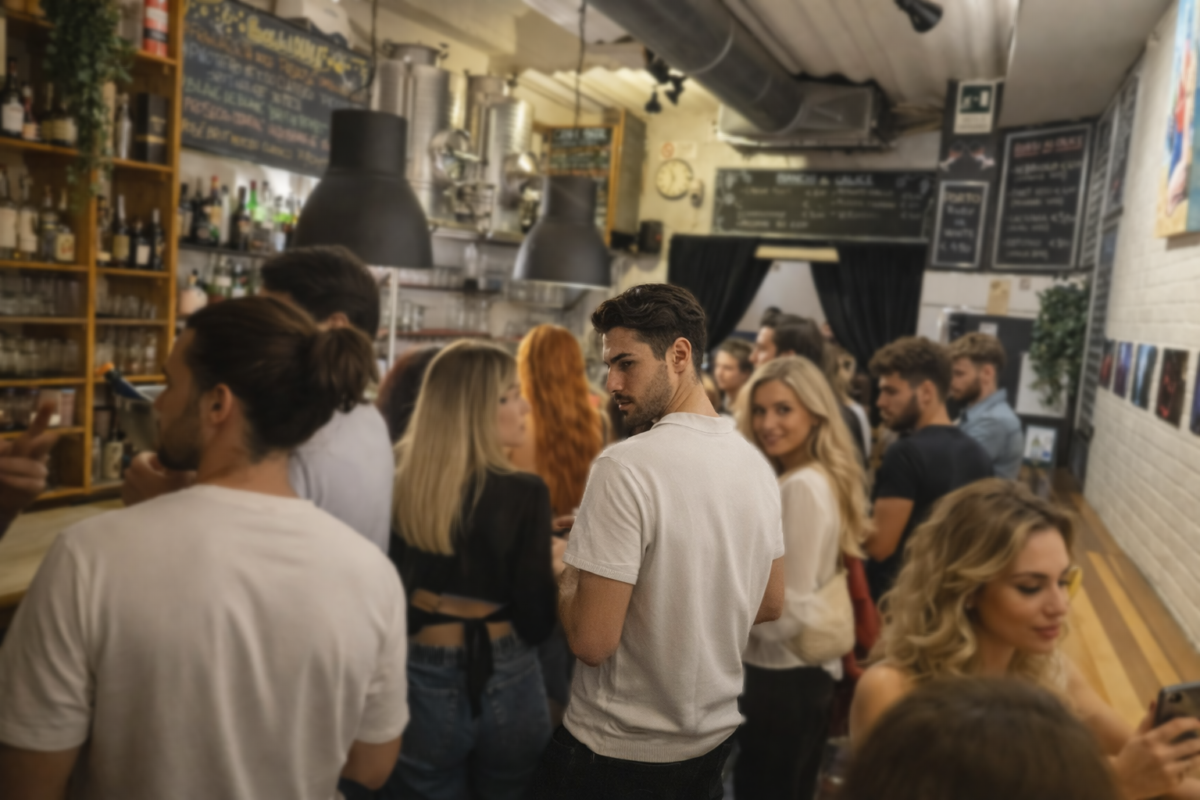
There is a difference between being alone and being lonely. Most cities have forgotten this. The social infrastructure of contemporary urban life is built almost entirely around groups: tables for two, reservations for four, events designed for couples and friend circles. The person who walks into a bar alone, sits at a table alone, attends a concert alone, is treated — by the space, by the staff, sometimes by other guests — as an anomaly. Someone waiting for someone else. Someone to be pitied, or at least gently managed.
This is not a minor design flaw. It is a cultural assumption with real consequences. It tells people that being alone in public is a lesser state — a temporary condition to be resolved rather than a legitimate, even desirable, way of being in the world. And it excludes, quietly but systematically, a large number of people: those who have just moved to a city, those who travel alone, those who simply prefer their own company on a given evening, those whose social networks have changed or contracted, those who want to encounter something new without the insulation of a familiar group.
The question is not psychological. It is architectural, spatial, political. What kind of places allow a person to be alone in public without feeling exposed? What kind of hospitality treats the solitary guest not as a problem but as a welcome presence?
The disappearance of the third place
The sociologist Ray Oldenburg coined the term “third place” to describe spaces that are neither home nor work — cafés, bars, barbershops, public squares — where people gather informally, without agenda, without the obligation of consumption or productivity. Third places, he argued, are essential to civic life. They are where strangers become acquaintances, where social bonds form across class and age and background, where the city becomes something more than a collection of private apartments connected by commercial corridors.
The problem is that third places are disappearing. Or rather, they are being replaced by spaces that look similar but function differently. A chain café with individual tables, laptop screens, and noise-cancelling headphones is not a third place. A bar designed for Instagram — where the lighting, the menu, and the furniture exist primarily to be photographed — is not a third place. These are commercial environments optimized for individual consumption, not for encounter. You can spend an evening in them without speaking to anyone, without being spoken to, without the faintest possibility that something unplanned might happen.
The difference matters. A genuine third place has a quality that is difficult to engineer and impossible to fake: it makes solitude social. You can sit alone and still feel part of something — a room, a conversation, a shared attention to what is being played or poured or shown on the walls. The French have a phrase for it, être seul ensemble — to be alone together. It describes the specific comfort of being in a place where your presence is acknowledged without being interrogated, where you can participate or withdraw as you choose, where the space itself does the work of inclusion.
What Bologna still has
Bologna, for historical and structural reasons, has preserved more of this than most European cities of comparable size. The portici — the covered walkways that run for nearly forty kilometres through the city — are themselves a form of public solitude: you walk alone, but sheltered, visible, among others. The piazzas are not decorative. People sit in them. Students, pensioners, workers on a break, tourists who have stopped performing the role of tourist for a moment. The city’s layout encourages a kind of slow, porous movement between public and private, between being with others and being with yourself.
The bars and osterie that have survived the last two decades of rising rents and commercial homogenization tend to share certain qualities. They are small enough that the staff recognizes faces. They are informal enough that sitting alone at a table does not require explanation. They serve food and drink at prices that do not punish the person who has come for one glass and the pleasure of being somewhere that is not home. And many of them — not all, but many — maintain some relationship with art, music, or conversation that gives the room a texture beyond consumption.
This is not nostalgia. It is a description of something that still exists but is under pressure everywhere — in Bologna as in every other city where the logic of tourism, real estate speculation, and platform-driven commerce is reshaping what public space looks like and who it is for.
Hospitality as ethics
There is a word that gets used loosely in the food and drink industry — hospitality — that deserves to be taken more seriously. In its commercial sense, it means service: efficiency, attentiveness, the smooth management of a customer’s experience. But in its older, deeper sense — the sense that runs through Greek, Hebrew, Arabic, and Christian traditions — hospitality means something closer to the ethical treatment of the stranger. Not the friend, not the regular, not the person who arrives with a group and a reservation. The stranger. The one who walks in alone, without context, without social armor, and who is welcomed not because they will spend a certain amount of money but because they are there.
A bar that understands this — that treats the solitary guest as a full participant in the life of the room, not as a reduced version of a group — is doing something more than selling drinks. It is maintaining a form of public life that the market, left to its own logic, would eliminate. Because the market prefers groups: groups spend more, stay longer, generate more content for social media, and are easier to manage. The person who comes alone is commercially inefficient. But they are civically essential. They are the proof that a place is genuinely public — open to whoever walks in, for whatever reason, at whatever hour.
Adorno and damaged life
Theodor Adorno, whose Minima Moralia gave its name to the company behind this website, wrote extensively about the damage that modern life inflicts on the individual’s capacity for genuine experience. He was not sentimental about solitude — he did not romanticize the lonely genius or the misunderstood outsider. But he understood that the pressure to always be social, always connected, always performing a role within a group, is itself a form of unfreedom. The person who cannot be alone — who panics at the absence of stimulation, who fills every silence with noise, who requires the constant validation of others to feel real — is not free. They are dependent. And a culture that makes solitude unbearable is a culture that has, in Adorno’s terms, damaged the very capacity for autonomous experience.
The counterargument is not isolation. It is the existence of places where solitude and sociality are not opposed — where you can be alone without being cut off, where the room itself mediates between the individual and the collective. This is what the best bars, the best piazzas, the best public spaces have always done. They hold the tension. They make it possible to be present without being absorbed.
A practical note
If you are in Bologna and you want to go out alone — for a glass of wine, for music, for the simple pleasure of being somewhere — there are a few things worth knowing. The city is safe and walkable at night. The historic center is compact enough that you can move between piazzas and streets on foot without planning. Many bars serve food as part of the aperitivo or throughout the evening, so there is no need to worry about finding a separate place to eat. And the culture, in general, does not treat the solitary drinker or diner as unusual. Italians have a long tradition of the passeggiata — the evening walk — and of sitting alone in public with a coffee or a glass of wine, watching the city move around them.
Piazza San Francesco, in particular, is a square that works well for this. It is residential, not touristic. The steps of the basilica fill up in the evening with people who live nearby. The bars around the piazza serve the neighborhood. There is music some nights, art on the walls, conversation if you want it and quiet if you do not. It is the kind of place where you can sit with a glass of wine and a book and feel — not lonely, not entertained — simply present.
Altotasso, in Piazza San Francesco 6/d, has been this kind of place since 2004. An enoteca and cultural space that was built on the idea that the freedom to choose what you drink, what you look at, and who you talk to — or whether you talk at all — is not a luxury. It is the minimum condition for a dignified evening out. The wines are selected directly from independent producers. There are exhibitions on the walls, live music, and the kind of atmosphere that Oldenburg would have recognized: a genuine third place, open to whoever walks in.
Going out alone is not a symptom. It is a skill, a preference, and sometimes a necessity. Cities that make it easy are better cities. Bars that make it welcome are better bars. And the freedom to be comfortably alone in a room full of strangers — to watch, to listen, to think, to simply be — is one of the small, concrete freedoms that make urban life worth the trouble.
Minima Moralia srl · Piazza San Francesco 6/d · Bologna · info@altotasso.com · altotasso.com